Larry Smarr, a physicist whose work at the University of Illinois at Urbana-Champaign on calculating black hole collisions led him to champion a federal commitment to dramatically enhance U.S. computing power – which in turn led to the development of NCSA Mosaic, the precursor to web browsers – was named today as the first 2014 recipient of the Golden Goose Award, which goes to three or four winners annually.
Attention modification programs, which train a person to ignore or disregard specific, problematic cues or triggers, have been used effectively to treat cases of anxiety and substance abuse. In a novel study published this week in the journal Appetite, Kerri Boutelle, PhD, professor of pediatrics and psychiatry at the University of California, San Diego School of Medicine, and colleagues report using a single session of attention modification to decrease overeating in obese children.
Researchers at the University of California, San Diego School of Medicine have discovered that a well-known protein has a new function: It acts in a biological circuit to determine whether an immature neural cell remains in a stem-like state or proceeds to become a functional neuron.
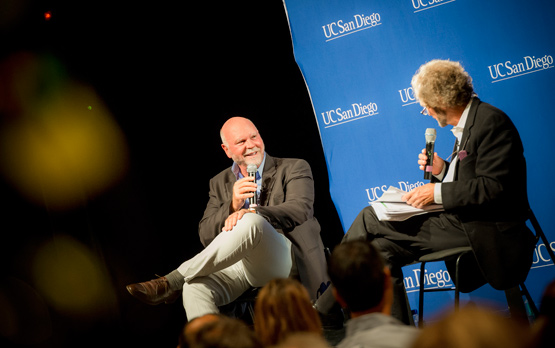
If J. Craig Venter has a single mantra, among so many that define his knack for discovery, it would be that human beings are essentially “DNA-driven software machines.”
It only takes a few minutes of chatting with J. Craig Venter to understand what first attracted him to return to his alma mater to open a research facility here. Venter’s approach to the scientific endeavor clearly matches that of the campus that first gave him his start. Both are mavericks known for bringing out-of-the-box thinkers together from across a wide spectrum of disciplines in search of the next blockbuster scientific breakthrough.
While smoking among California adults has dramatically declined in recent decades, researchers at the University of California, San Diego School of Medicine report there is a surprisingly large number of people who say they use cigarettes, but don’t consider themselves to be “smokers.”