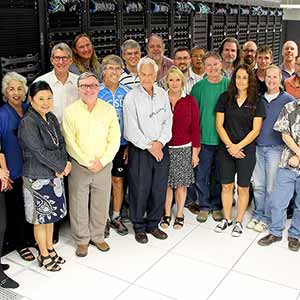
A team of students from the University of California, San Diego recently took home third place at the 2013 Mobile World Congress (MWC) after pitching their “Best Time to Cross the Border” app to a panel of judges from technology powerhouses such as Facebook and China Mobile.
An international team of scientists, led by researchers at the University of California, San Diego School of Medicine, says a key protein in Schwann cells performs a critical, perhaps overarching, role in regulating the recovery of peripheral nerves after injury. The discovery has implications for improving the treatment of neuropathic pain, a complex and largely mysterious form of chronic pain that afflicts over 100 million Americans.
Since the plate tectonics revolution of the 1960s, scientists have known that new seafloor is created throughout the major ocean basins at linear chains of volcanoes known as mid-ocean ridges. But where exactly does the erupted magma come from?
Five University of California, San Diego scientists and professors are among the first class of the Fellows of the American Association for Cancer Research Academy, created to recognize researchers whose scientific contributions have propelled significant innovation and progress against cancer. The entire class consists of 106 individuals, to celebrate the 106 year anniversary of AACR, the world’s first and largest professional organization dedicated to advancing cancer research.
Soon after the conclusion of its conference on the University of California, San Diego campus about the future of research networks in California, the Corporation for Education Network Initiatives in California (CENIC) announced a record-breaking year for the network that provides high-performance connectivity to over 10 million Californians every day.
In the early 1940s, California fishermen hauled in a historic bounty of sardine at a time that set the backdrop for John Steinbeck’s “Cannery Row” novel. But by the end of the decade the nets came up empty and the fishery collapsed. Where did they all go? According to a new study led by scientists at Scripps Institution of Oceanography at UC San Diego, the forces behind the sardine mystery are a dynamic and interconnected moving target.