Artist, Software Engineers Showcase ‘Dreamscapes’ on Calit2 Visualization Wall
Calit2 director Larry Smarr welcomes artist Daniel Ambrosi to Qualcomm Institute to showcase full-size art works for first time ever at highest resolution.
Calit2 director Larry Smarr welcomes artist Daniel Ambrosi to Qualcomm Institute to showcase full-size art works for first time ever at highest resolution.
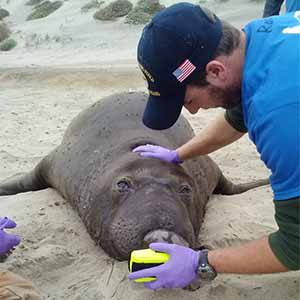
In a new study, most marine mammals were found to exhale carbon monoxide at levels equivalent to or greater than the amount exhaled by a several-packs-a-day smoker.
Researchers at the University of California, San Diego School of Medicine have launched a new four-year, $3.7 million multidisciplinary research center to investigate the relationship between sedentary behavior and cardiovascular risk factors in Latinas, who have a disproportionately higher chance of developing heart disease than the general population.
More walkable neighborhoods, parks and public transit could all reduce your chance of becoming one of the 600 million adults who battle obesity worldwide, according to researchers at University of California, San Diego School of Medicine. The study, recently published online in The Lancet, found a neighborhood’s design plays a critical role in physical activity and could help reduce non-communicable diseases, such as obesity, diabetes and cardiovascular disease.
Students from a structural engineering and a visual arts class are working together, shoulder to shoulder, on a collaborative final project despite the fact that they are in different classes. This visual arts and engineering mashup is happening in the new EnVision Maker Studio at UC San Diego and involves students in Structural Engineering 1 and Visual Arts 40.
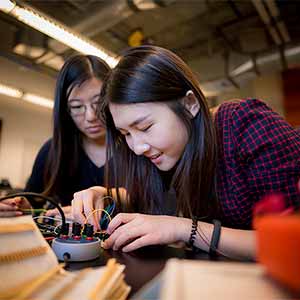
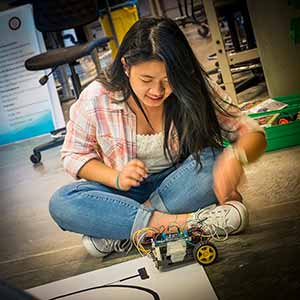
The EnVision Arts and Engineering Maker Studio at UC San Diego teemed with excitement on the day of the final in an electrical engineering class called Making, Breaking and Hacking Stuff. Instead of a typical test, the class culminated in a cumulative final project – teams of two or three students used the knowledge and some of the parts they had acquired during the class’s previous projects to build a line-following robot. The teams competed to see who programmed their robot to follow a line most closely, and at the fastest speed.
Keep up with all the latest from UC San Diego. Subscribe to the newsletter today.