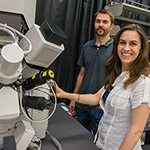
Each year, approximately 600,000 total knee replacement procedures are performed in the United States, a number that is expected to rise in the next decade as the population ages. UC San Diego Health System is the first in the nation to use iASSIST, a computer navigation system with Bluetooth-like technology that improves surgical precision and accuracy in total knee replacements, decreasing the need for revision surgery.
The University of California, San Diego and Comhear, Inc., a transformational, audio technology and wearables company, today announced that they are collaborating on the latest in audio conferencing technology. Comhear has prototyped the first in a series of revolutionary new products designed to let users customize their listening environment, based on an exclusive license for audio beamforming technology developed by researchers in the Qualcomm Institute, the UC San Diego division of the California Institute for Telecommunications and Information Technology (Calit2).
Researchers studying peptides using the Gordon supercomputer at the San Diego Supercomputer Center (SDSC) at the University of California, San Diego (UCSD) have found new ways to elucidate the creation of the toxic oligomers associated with Alzheimer’s disease.
Larry Smarr, a physicist whose work at the University of Illinois at Urbana-Champaign on calculating black hole collisions led him to champion a federal commitment to dramatically enhance U.S. computing power – which in turn led to the development of NCSA Mosaic, the precursor to web browsers – was named today as the first 2014 recipient of the Golden Goose Award, which goes to three or four winners annually.
Attention modification programs, which train a person to ignore or disregard specific, problematic cues or triggers, have been used effectively to treat cases of anxiety and substance abuse. In a novel study published this week in the journal Appetite, Kerri Boutelle, PhD, professor of pediatrics and psychiatry at the University of California, San Diego School of Medicine, and colleagues report using a single session of attention modification to decrease overeating in obese children.
Mexico’s most visionary leaders, vibrant culture, past accomplishments and future goals will be the focus of the University of California, San Diego’s Mexico Moving Forward symposium, from 8:30 a.m. to 6 p.m. on March 6. The symposium, hosted by the Center for U.S.-Mexican Studies at the School of International Relations and Pacific Studies, will focus on Mexico’s progress and future goals 20 years after the signing of the North American Free Trade Agreement (NAFTA). It also will feature University of California President Janet Napolitano, UC San Diego Chancellor Pradeep K. Khosla and the School of International Relations and Pacific Studies Dean Peter Cowhey, as well as experts from both sides of the border.