Patients at UC San Diego Health can now read the medical notes signed by their primary care physician. This move toward transparency is part of an international trend to make patients feel more in control of their health care.
Researchers at University of California San Diego School of Medicine discovered that they can block inflammation in mice with a naturally occurring antibody that binds oxidized phospholipids (OxPL), molecules on cell surfaces that get modified by inflammation. Even while on a high-fat diet, the antibody protected the mice from arterial plaque formation, hardening of the arteries and liver disease, and prolonged their lives.
For the second year in a row, the London-based Times Higher Education ranked UC San Diego the world’s number one research university founded during the “golden age” of higher education development, in the two decades between 1945 and 1967—when higher education was characterized by rapid university expansion and increasing investment in research.
Reporting results from a first-in-human phase I clinical trial, researchers at University of California San Diego School of Medicine have found that treatment with cirmtuzumab, an experimental monoclonal antibody-based drug, measurably inhibited the “stemness” of chronic lymphocytic leukemia cancer (CLL) cells — their ability to self-renew and resist terminal differentiation and senescence.
Researchers at University of California San Diego School of Medicine report that a first-in-human phase I clinical trial in which neural stem cells were transplanted into participants with chronic spinal cord injuries produced measurable improvement in three of four subjects, with no serious adverse effects.
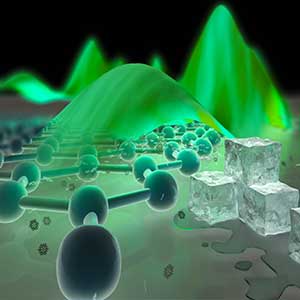
To begin to understand the field of plasmonics, picture the rich colors of stained glass windows in Gothic cathedrals; or, the pixelation of a digital photo on a laptop screen. In some way, shape or form these are plasmons on display. Basically, plasmons are traveling waves of rippling electrons that can be excited in plasmas, metals or semiconductors. They lie at the heart of plasmonics. In such systems, plasmons bunch up and spread out as a group, enhancing and manipulating electromagnetic energy and concentrating optical energy beyond the diffraction limit of light. But much of this energy in common materials is quickly lost, or dissipated, as heat. And, while plasmons have found commercial applications in chemical sensors (e.g., common drug-store pregnancy tests), they have not been applied more widely or ambitiously because of high dissipation, which has frustrated scientists—until now.