Don’t Count on Your Chickens Counting
Arguing against the current conventional wisdom – that there is an evolved capacity for number and arithmetic that we share with other species – Rafael Nunez says numerical cognition is not biologically endowed.
Arguing against the current conventional wisdom – that there is an evolved capacity for number and arithmetic that we share with other species – Rafael Nunez says numerical cognition is not biologically endowed.
On April 19, one department and 11 members of the UC San Diego community were recognized at the 7th Annual Integrity Awards Ceremony for their contributions to academic, research and professional integrity on campus. The awards were hosted by the Academic Integrity Office and Research Ethics Program to honor our university’s commitment to uphold the six pillars of integrity—responsibility, honesty, fairness, respect, trustworthiness and courage.
A sampling of the works from artist Ted Meyer’s intriguing Scarred for Life series will be on display, beginning May 15 through September 1, 2017, in the Biomedical Library Building breezeway. The exhibit and an opening reception on May 15 are a collaboration between the UC San Diego Library and Oceanside Museum of Art, which is holding a major exhibition of the artist’s work—Ted Meyer: Scarred for Life— from May 27 through September 17, 2017.
As president of the student-run Virtual Reality Club at UC San Diego, Connor Smith says VR interest is at an all-time high among undergraduate students at UC San Diego. “We were lucky to see anyone here in the lab before winter quarter,” added Smith. “Now, we’re absolutely packed much of the time, and membership will continue surging, particularly from students enrolled in VR courses who get hooked on VR development.”
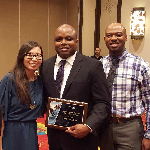
Anthony Singleton, UC San Diego’s chief small business officer, has been named 2017 Small Business Administration (SBA) Minority Small Business Champion of the Year by the U.S. SBA’s San Diego District Office. The Minority Small Business Champion of the Year Award recognizes an individual who has demonstrated an outstanding commitment to minority-owned small businesses and has gone above and beyond to ensure that they succeed. Nominated by the North San Diego County Business Development Center (SBDC), Singleton was recognized for his outreach efforts and community service to small businesses within the San Diego and Imperial Counties.
Ever since elementary school, UC San Diego senior biology major Jackie Nguyen knew she wanted to be an optometrist. She also knew she needed help preparing her application for optometry school, so she headed to UC San Diego’s career services for pre-health students, newly rebranded as Health Beat. Here, she was able to schedule advising appointments and receive individual help with her personal statements and interview preparation. She calls the experience “extremely valuable and helpful in my process of applying to school.”
Keep up with all the latest from UC San Diego. Subscribe to the newsletter today.