Learning to See Beyond the Exam Room
Medical Students Explore Barriers to Care

Story by:
Media contact:
Published Date
Story by:
Media contact:
Topics covered:
Share This:
Article Content
At some point most of us have had to make a doctor’s appointment or pick up a prescription. Often the processes for these fairly routine tasks can be confusing and difficult to accomplish. Finding the correct phone number or locating the correct location we need to visit can be daunting, as a result we might be less inclined to make or even attend appointments.
Mai Hoang, M.D., associate clinical professor in the Department of Obstetrics, Gynecology and Reproductive Sciences, noted that even as a physician, sometimes making appointments for herself when she was pregnant was not always easy.
Last fall, 20 first- and second-year medical students enrolled in a 12-week elective course designed by Hoang to help teach medical students about some of the barriers to care that patients experience in hopes of cultivating empathy and promoting compassion among pre-clinical medical students. The students met in the classroom for didactic sessions where they learned different topics, from prenatal and postpartum care, to how to provide care in a culturally respectful manner. There was also a portion of the course that took place in the clinical environment. This course marked the first medical elective course that combined formal classroom instruction with the clinical experience of care navigation and patient interactions.
“In medical school we learn how to become a doctor - how to treat and diagnose diseases. But we don’t always learn about what happens outside the exam room and how those factors can impact the care we provide as well as patient outcomes,” said Hoang. “The unique combination offered by this course fostered compassion and empathy through lived experience as students directly witness the challenges that patients have to go through just to arrive to an appointment.”
Challenges can include obtaining insurance, securing transportation to and from appointments, and finding childcare for young children. Additionally, some patients are unhoused and require assistance with accessing other community resources.
Just exposing the students to the unique circumstances affecting patients proved beneficial to shifting the student’s mindset.
For second-year medical student Brianna Dzyuba, the course lectures helped her to become more culturally competent by teaching her about advocacy, trauma-informed care, mental health and culturally competent care.
“This course showed me the real-life barriers patients face,” said Dzyuba. “These experiences reminded me how easily social circumstances beyond a patient’s control can affect their care, and how important it is for providers to approach such situations with empathy and understanding. This course allowed me to connect ethical principles to real patient experiences.”
Hoang noted that Dzyuba’s experience represents the heart of what the course set out to achieve.
“In order to become capable and compassionate physicians, students must be able to make evidence-based recommendations while considering patient-specific factors including barriers to care,” said Hoang. “Although this course focused on marginalized patients, the goal is to increase compassion and empathy among future generations of physicians. By increasing the compassion and capacity of future physicians to care for minoritized patients, we can improve quality and comprehensive care for all patients.”
Through an end of the course survey, Hoang noted that 89% of students reported that the course increased their compassion and empathy, while 72% of students reported that the course increased their connection/ purpose to medicine. The students also reflected on increased appreciation for all members of the patient-care team. They gained an overall better understanding of how important care collaboration is to assure the best possible outcomes for each patient. Through the course, they learned concrete skills that will assist them when they are working as residents and fellows. As an example, they learned how to work with the interpreters and to think creatively about how to assist patients with accessing care.
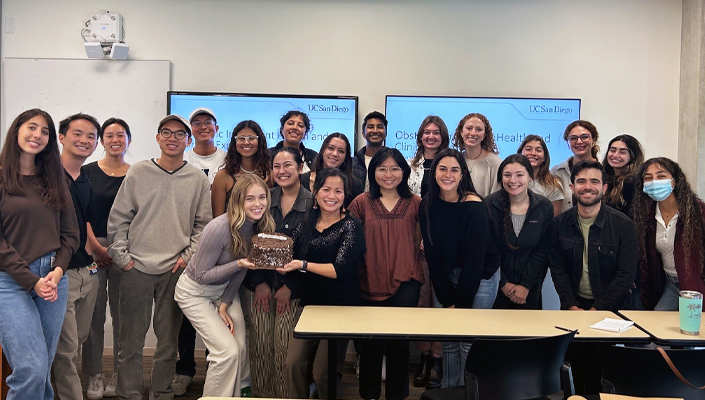
Dr. Hoang and the inaugural class of medical students who completed a 12-week elective course which focused on fostering emapthy and compassion as student saw first hand the challenges that some patients face in accessing care. Photo courtesy of Mai Hoang.
“I was always aware of the barriers and difficulties that vulnerable patients faced in accessing care,” said Dzyuba, who is looking forward to now serving as a teaching assistant in the course. “By the end of the course, I felt that I could genuinely empathize with my patients, having witnessed how difficult it can be for them to access, navigate and continue care.”
While medical students learn the science of medicine in classrooms, teaching the heart of medicine can require a bit more intentionality.
“Through this experience, the students experienced the importance of multidisciplinary collaboration in the care of medically and socially complex patients,” said Hoang. “Physicians can't improve a person's health if the person can't attend appointments due to transportation barriers. Similarly, we can’t help patients if they are unable to take prescribed medication because they are unhoused and the medication requires refrigeration. Therefore, it is crucial that medical students can comfortably and successfully collaborate with social workers, case managers and community health workers in order to provide excellent inclusive care and optimize outcomes.”
For Dzyuba, the course met its objectives. “The lessons (from this class) deepened my understanding of how to support patients holistically and advocate for them with integrity,” she said. “And deepened my commitment to caring for patients ethically, with integrity and respect for their individual circumstances.”
You May Also Like




Stay in the Know
Keep up with all the latest from UC San Diego. Subscribe to the newsletter today.
