Research Alerts
How Does the Brain Control Its Own Blood Flow?


Published Date
Article Content
Blood vessels in the brain are highly interconnected and efficient in actively regulating blood flow. Yet, the mechanisms that regulate flow are not well studied on a holistic level. To determine how the brain can reliably control such a seemingly complicated network, UC San Diego Professor of Physics David Kleinfeld and Postdoctoral Scholar Xiang Ji formulated a mathematical model that uses the measured connections among vessels to predict the impact of a change in a single vessel on the flow through all the other vessels.
Theory predicts that only specially configured vessels, namely “transition zone capillaries” as they branch off from their supply arterioles, can reliably modulate flow. These predictions were validated by analyzing the experimental data of Kai Wang at the Institute of Neuroscience in Shanghai. More so, given the observed organization and arrangement of blood vessels, theory predicts that these same capillaries must dilate in a coordinated fashion to assure the reliable control of flow. Large-scale testing of this prediction is underway in the Kleinfeld laboratory.
This work highlights principles of organization for the control of blood flow among the seemingly random connectivity of brain microvessels. It has strong implications for medicine and for the interpretation of magnetic resonance imaging studies in cognitive neuroscience.
The study, published January 15, 2026 in PNAS, was led by Xiang Ji and David Kleinfeld (both UC San Diego) and Zhao Yuchen, Bai Lu and Kai Wang (Chinese Academy of Science). Their research was funded, in part, by the National Institutes of Health (R35 NS097265 and U19 NS137920).
Read the study in PNAS: “Microvascular architecture and physiological fluctuations constrain the control of cerebral microcirculation."
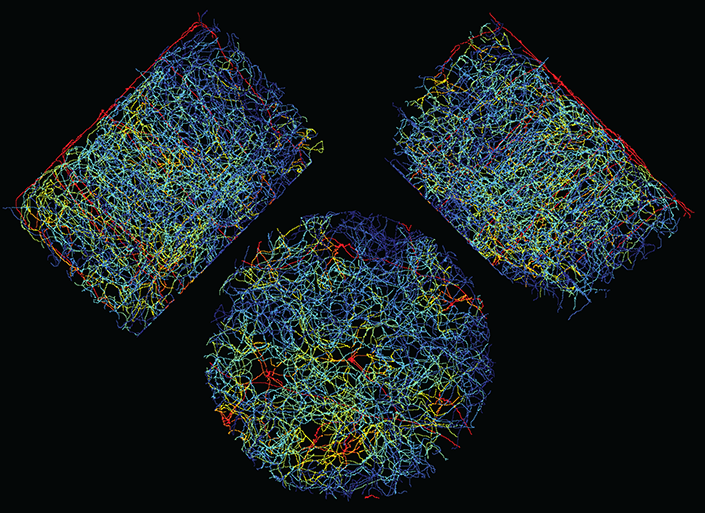
Mouse brain vasculature in a 0.8 mm diameter region of cerebral cortex, labeled to highlight regions of reliable control of blood flow in red. The top-down view and side views are shown.
Share This:




Stay in the Know
Keep up with all the latest from UC San Diego. Subscribe to the newsletter today.
