How Bad Bunny Became a Global Cultural Force


Published Date
Article Content
When Bad Bunny takes the Super Bowl halftime stage this weekend, he will do so at a moment when his influence on music, performance and popular culture has never been greater.
Fresh off a history-making Grammy win for “Debí Tirar Más Fotos” — the first Spanish-language album to earn Album of the Year — the Puerto Rican superstar born Benito Antonio Martínez Ocasio is set to bring his music, movement and distinctive style to one of the biggest stages in global entertainment. Known for blending reggaeton and Latin trap with bold fashion, expressive choreography and an unapologetic commitment to singing in Spanish, Bad Bunny has become one of the most-streamed artists in the world while remaining deeply rooted in Puerto Rican culture and identity.
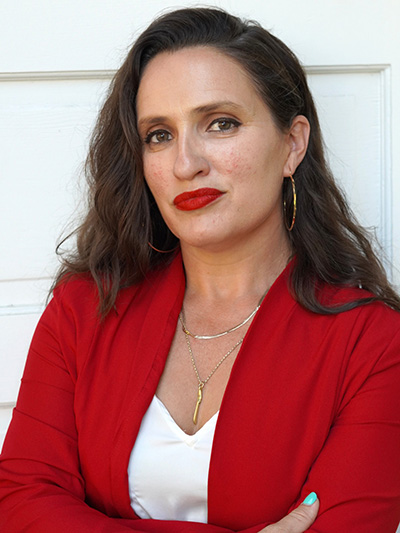
Jade Power-Sotomayor
What does it mean for an artist like Bad Bunny to headline the Super Bowl halftime show, and why does this moment carry significance far beyond the stage?
To unpack this Super Bowl moment, we spoke with alumna Jade Power-Sotomayor, MA '06, PhD '12, a Puerto Rican scholar and assistant professor in UC San Diego’s Department of Theatre and Dance, where she also serves as head of performance studies and director of the Chicanx and Latinx Studies Program. Power-Sotomayor’s research examines how movement, sound and the body function as forms of cultural expression, a focus that also shapes her forthcoming book, “¡Habla! Speaking Bodies and Dancing Our América.”
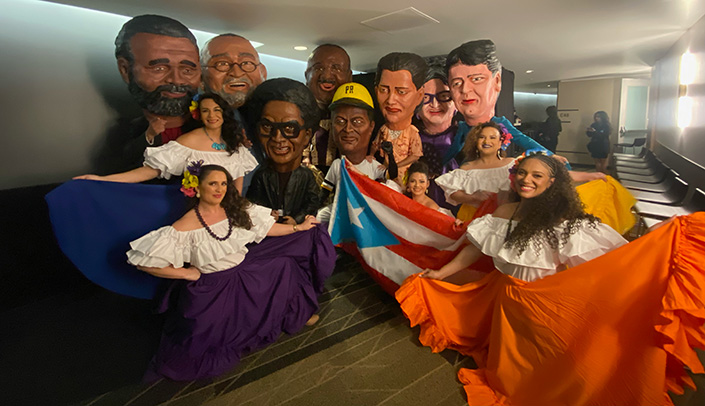
Pictured backstage at the 2023 Grammy Awards, Jade Power-Sotomayor (bottom left in the purple skirt) prepared to take the stage with Bad Bunny, performing "plena," a traditional Puerto Rican drum-dance form. (Photo courtesy of Jade Power-Sotomayor)
She also brings a rare perspective to the conversation: In 2023, Power-Sotomayor appeared as a dancer in Bad Bunny’s Grammy performance, performing “plena,” a traditional Puerto Rican drum-dance form. Ahead of the Super Bowl, she shares insights into how Bad Bunny’s use of movement, performance and language helps explain both his global reach — and why this halftime show represents something much bigger than entertainment:
What feels significant, culturally or historically, about Bad Bunny taking the Super Bowl halftime stage?
Benito performed at the Super Bowl halftime show as a guest in 2020 for Shakira and Jennifer Lopez’s performance, which drew attention to how Latinx presence and politics entered that global stage. I see this year’s Super Bowl as a continuation of that moment, but unlike Shakira and Jennifer Lopez, his global popularity has been achieved without ever singing in English.
While there has been a lot of discussion about the fact that Bad Bunny’s songs are in Spanish and what that might mean for U.S. audiences, there has also been a powerful counter-discourse that insists on music’s power to unite people across differences, whether linguistically or culturally. Pointing to past artists whose lyrics aren’t immediately transparent or intelligible, these arguments underscore how Bad Bunny’s presence on this global stage challenges assumptions about who belongs.
If millions of people can unite in the shared joy of dancing to the same beat, that alone speaks volumes about the cultural significance of this moment.
He’s spoken about his halftime show being “for my people, my culture and our history.” How do you see his performances functioning as acts of cultural expression rather than just entertainment?
Performance scholars think about performance as a kind of “doing,” or a way of bringing things into being. From that perspective, expression and entertainment are not really opposites — many performances are doing both at the same time.
That said, the fact that Puerto Rican culture and history are receiving such critical and nuanced exposure on a global scale is extremely significant, especially given how little many people understand about Puerto Rico’s place in U.S. history. While there have been other public figures who represent Puerto Rico, Puerto Ricans, when depicted at all, are often reduced to narrow or caricatured representations. The Super Bowl, or “Benito Bowl” as some are calling it, feels like affirmation, respect and celebration. It feels both very personal and very consequential.
What do you think has allowed Bad Bunny’s work to resonate so powerfully across cultures and borders?
Bad Bunny is a fascinating figure whose personal and artistic work opens onto a range of timely issues. This includes the ambiguity of his at-times genderqueer presentation and his pointed critiques about the norms of masculinity. It also includes his definitive and unabashed, but not clichéd, anticolonial politics — especially through invocations of Puerto Rico as land and place and Puerto Ricans as creators of meaningful culture. At the same time, he positions himself as an advocate for feminism and for trans and queer inclusivity. His global stardom is clearly a result of his originality and creative genius, as well as a combination of market forces working in his favor.
That said, much of what has marked his success has been his insistence on remaining tied to everyday life in Puerto Rico, using slang, humor and cultural references that speak to people's lived experiences in a place that is both extremely beautiful but also full of challenges. While his music does promote a degree of flag-waving nationalism, for the most part it avoids overly clichéd or generalized patriotism. Rather, he celebrates Puerto Rico and Puerto Ricans through precise attention to cultural histories and shared experiences. “El que sabe, sabe”: If you know, you know.
By extension, because the conditions in Puerto Rico are recognizable across the Americas, his music and stance have strongly resonated beyond the archipelago. For many Latine listeners, his continued choice to sing in Spanish — despite industry pressures to “cross over” — signals a commitment to his audience rather than to assimilation into the mainstream. This creates a kind of authenticity that has further contributed to his popularity across cultures.
His global popularity is also due to how his music feels in the body. It makes people want to move, to dance, to groove.
Grammy-winning “Debí Tirar Más Fotos” marked a new moment in Bad Bunny’s career. What stands out to you about the album, and how does it reflect the broader themes in his work?
The album is a love letter to his culture and homeland that draws on a rich repertoire of Puerto Rican musical traditions, creating connections across generations. In using the sounds of genres such as bomba, plena, salsa, bolero, and aguinaldo alongside reggaetón and trap, he places himself in a lineage of artists and innovators, largely Afro Caribbean, who have used music and dancing as forms of survival and resistance. He is not singularly talented, but rather his artistry reflects those who have come before. The compositions on the album, however, despite drawing on older genres, feel entirely original and new as the lyrics and structure are firmly within Benito's personal style.
The album overall, as we hear in the title song, “Debí Tirar Más Fotos (I Should Have Taken More Photos)”, is about the importance of remembering and honoring moments of intimacy with loved ones before they are inaccessible to us. This is a personal reminder to enjoy people while they are with us, and also to recognize the value of our land and culture so that we may protect it from gentrification and erasure. Importantly, many songs, starting with the album's opening track, “NUEVAYoL”, also name and recognize the realities of Puerto Rican migration, and the nostalgia that is felt in leaving one's homeland. In this way, the album is not only a bridge across generations, it is a bridge across different Puerto Rican geographies. And of course, it's all in Spanish — Puerto Rican Spanish! Other Spanish speakers and Spanish-language media have historically maligned Puerto Ricans for having an inferior way of speaking, which is full of aspirated consonants and Anglicisms. The fact that this is the Spanish-language album being celebrated at this moment is also a challenge to these hierarchies.
Bad Bunny often blends music, movement, fashion and performance in ways that challenge expectations. How does he use the body and movement as part of his storytelling?
For many Latine and Latinx listeners, his continued choice to sing in Spanish — despite industry pressures to “cross over” — signals a commitment to his audience rather than to assimilation into the mainstream.
One of the things that strikes me about his performances is how he is both totally captivating as an individual and how he fills and shares his stage with dancers, musicians and collaborators whose energies he plays with. From the beginning he has been a trendsetter — from his little round sunglasses to his painted nails — and the political stance he took in wearing a skirt to decry the killing of Puerto Rican trans woman Alexa.
In his live performances, I also note how playful he is on stage. His waist winding and hip thrusting are simultaneously a way to groove to the music and a wink to the politics of respectability he continuously upends. In his 2025 summer “Residencia” concerts in Puerto Rico, which turned into the “Debí Tirar Más Fotos” world tour, he changed his outfits multiple times, aligning with different affective registers and stylistic trends. Together, these choices tell a story about contemporary Puerto Rican life that is both rooted in tradition and highly experimental.
For viewers who may be encountering Bad Bunny for the first time during the Super Bowl, what do you hope they notice or take away from his performance?
His artistic choices are very deliberate and often carry layered symbolic meanings, but he is also playful with aesthetics in a way that reflects a deep curiosity and interest in boundary breaking. That boundary breaking is less an end in itself than a way of discovering new forms of meaning.
As a singer, he has an impressive range, hitting high notes that convey tenderness before dropping into his natural baritone with rhythmic play. He has what performance scholar Joseph Roach calls the “it factor,” drawing people in through a balancing of strength and vulnerability, innocence and experience, and singularity and typicality.
One of the things that strikes me about his performances is how he is both totally captivating as an individual and how he fills and shares his stage with dancers, musicians and collaborators whose energies he plays with.
Share This:




Stay in the Know
Keep up with all the latest from UC San Diego. Subscribe to the newsletter today.
