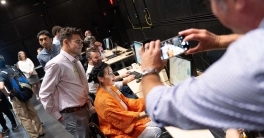
Neurodiverse Interns Showcase Their Talent in Tech
Enthusiasm, hard work and talent were on display at the end-of-summer Neurodiversity in Tech internship showcase at UC San Diego Qualcomm Institute’s Atkinson Hall.
Enthusiasm, hard work and talent were on display at the end-of-summer Neurodiversity in Tech internship showcase at UC San Diego Qualcomm Institute’s Atkinson Hall.
“My interest lies in building better tools,” said Zhaowei Liu, a faculty member in the UC San Diego Jacobs School of Engineering and affiliate of the university’s Qualcomm Institute. “I think I can have a bigger impact that way.”
A sweat-powered wearable has the potential to make continuous, personalized health monitoring as effortless as wearing a Band-Aid. UC San Diego engineers have developed an electronic finger wrap that monitors vital chemical levels—such as glucose, vitamins, and even drugs—present in the same fingertip sweat from which it derives its energy.
Students and professionals from all over the world travel to San Diego to take English as a Second Language courses offered by the English Language Institute within UC San Diego Extended Studies International Programs. For many of them, mastering English is not only a professional necessity and a gateway to greater opportunities but also a way to better serve their communities. Now, Extended Studies is leveraging cutting-edge research, cognitive science and robotics to help these constituents improve their English language skills.
The U.S. National Science Foundation (NSF) has renewed funding for OpenTopography, a science gateway that advances understanding of the Earth’s surface, vegetation and built environment. OpenTopography is a comprehensive platform for open access to high-resolution (one meter pixel resolution or better) and global topographic data that is utilized by an international community of researchers, educators, government agencies, industry and hobbyists.
In the Aug. 28, 2024 issue of Nature, researchers from University of California San Diego in the laboratory of Dr. Kevin King, associate professor of bioengineering and medicine, and a cardiologist at the Sulpizio Cardiovascular Center, report the discovery of a novel mechanism of cardiac inflammation that may expand therapeutic opportunities to prevent heart attacks from becoming heart failure.
Keep up with all the latest from UC San Diego. Subscribe to the newsletter today.