A recent whole-genome sequencing (WGS) analysis project supported by the San Diego Supercomputer Center (SDSC) at the University of California, San Diego has demonstrated the effectiveness of innovative applications of “flash” memory technology to rapidly process large data sets that are pervasive throughout human genomics research.
Two new studies involving Scripps Institution of Oceanography, UC San Diego researchers project that human influences will lead to a drier world as the 21st century progresses and offer an explanation of the mechanics behind the drying trend.
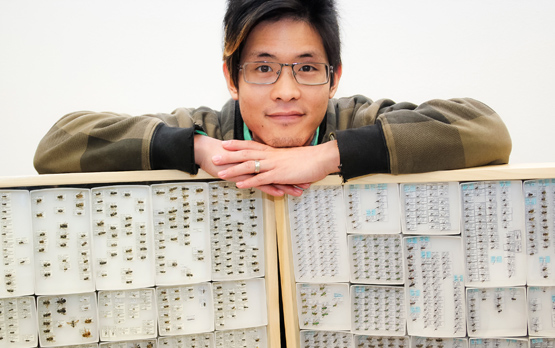
James Hung has collected more than 17,000 wild bees from coastal, desert and mountain areas of San Diego County. But many of his specimens bear little resemblance to the honey bees we normally think of as bees. To the casual observer, his bee collection looks more like a menagerie of Insects Gone Wild—gnat-sized bugs with long snouts, gigantic black bees and curious iridescent creatures with termite-like wings.
Turns out even the experts have difficulty wrapping their heads around the concept of how quickly – and drastically – what’s come to be called ‘big data’ has changed our daily lives. Defined as the gathering, storing and analysis of massive amounts of computerized data, both unstructured and multi-structured, big data keeps growing at almost unimaginable rates of speed.
A joint study by researchers at the University of California San Diego and the University of Toronto has found that a computer system spots real or faked expressions of pain more accurately than people can.
The University of California, San Diego Library has become the official repository for the papers of Jonas Salk, noted physician, virologist, and humanitarian, best known for his development of the world’s first successful vaccine for the prevention of polio.