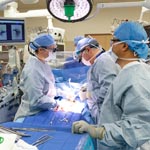
UC San Diego Health and its medical and surgical specialties have again been nationally ranked by U.S. News & World Report for 2018-19. Each year, U.S. News & World Report analyzes and reviews hospitals performance in a clinical specialties, procedures and conditions for its “Best Hospital” rankings. These rankings distinguish hospitals that provide excellent treatment for health conditions that require the most comprehensive care.
By stacking and connecting layers of stretchable circuits on top of one another, engineers have developed an approach to build soft, pliable “3D stretchable electronics” that can pack a lot of functions while staying thin and small in size. The work is published in the Aug. 13 issue of Nature Electronics.
To understand why some patients with appendix cancer respond to standard treatment while others do not, University of California San Diego School of Medicine and Moores Cancer Center researchers, in collaboration with Foundation Medicine, performed genetic profiling on 703 appendiceal tumors — the largest such study of this disease to date — to compare mutations present in both cancer types.
Researchers at University of California San Diego School of Medicine report that they have successfully created spinal cord neural stem cells (NSCs) from human pluripotent stem cells (hPSCs) that differentiate into a diverse population of cells capable of dispersing throughout the spinal cord and can be maintained for long periods of time.
Early Earth was a hot, gaseous, dusty and dynamic planet with an atmosphere and an ocean. Then its surface cooled and stabilized enough for clouds, landmasses and early life to form about four billion years ago, during what’s called the isotopic age of rocks, or the Archean Period. Atmospheric chemical byproducts from that time traveled through the air and deposited inside the planet’s oldest rock, recording life’s earliest activities like photosynthesis and oxygen production.
Sulfur isotopes can serve as tracers of atmospheric oxygen and new data collected from the present-day atmosphere in China by an international team of researchers, led by the University of California San Diego, indicate remarkable similarity to the isotopic footprint found in ancient rocks. This opens up new interpretations of the Archean Period’s sulfur isotope sedimentary signature—a proxy for the origins and evolution of atmospheric oxygen and early life on Earth.
For the first time, researchers at University of California San Diego School of Medicine and Imperial College London, with international collaborators, have determined that Kawasaki disease (KD) can be accurately diagnosed on the basis of the pattern of host gene expression in whole blood. The finding could lead to a diagnostic blood test to distinguish KD from other infectious and inflammatory conditions.