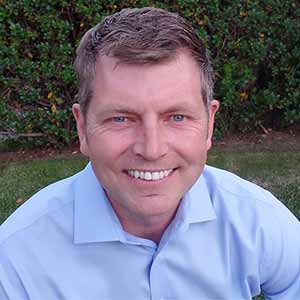
The University of California, San Diego has received an Andrew W. Mellon Foundation New Directions Fellowship grant—an award intended to assist humanities scholars in acquiring systematic training outside their areas of special interest—for the first time. The $209,000 grant will support Department of History Professor Mark Hendrickson’s efforts to explore how the work of American mining engineers and geologists working abroad between 1880 and 1930 helped shape the development of 20th-century American capitalism, science and foreign policy.
The University of California, San Diego Division of Arts and Humanities will be well-represented during the 42nd Annual Chancellor’s Associates’ Faculty Excellence Awards April 14, 6:00 p.m., at the Sanford Consortium for Regenerative Medicine on campus. During the event, Chancellor Pradeep K. Khosla will celebrate six exemplary faculty—three of whom hail from the arts and humanities division. They are: David O. Brink, distinguished professor in the Department of Philosophy, recognized for excellence in research in the humanities and social sciences; Teddy Cruz, professor of public culture and urbanism in the Department of Visual Arts, recognized for exemplary community service; and Anya Gallaccio, professor of visual arts, recognized for excellence in the performing and visual arts.
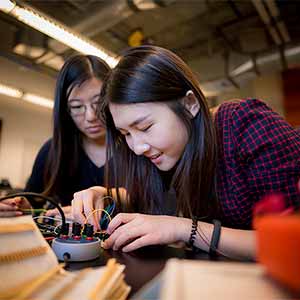
Students from a structural engineering and a visual arts class are working together, shoulder to shoulder, on a collaborative final project despite the fact that they are in different classes. This visual arts and engineering mashup is happening in the new EnVision Maker Studio at UC San Diego and involves students in Structural Engineering 1 and Visual Arts 40.
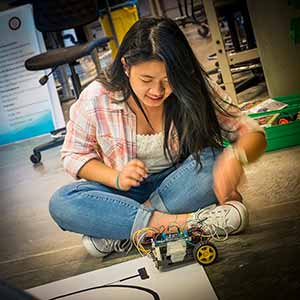
The EnVision Arts and Engineering Maker Studio at UC San Diego teemed with excitement on the day of the final in an electrical engineering class called Making, Breaking and Hacking Stuff. Instead of a typical test, the class culminated in a cumulative final project – teams of two or three students used the knowledge and some of the parts they had acquired during the class’s previous projects to build a line-following robot. The teams competed to see who programmed their robot to follow a line most closely, and at the fastest speed.
University of California, San Diego Department of Visual Arts Ph.D. candidate Stephanie Sherman was recently recognized for her achievements in art and activism by the Women’s Caucus for Art (WCA), which honored her with the President’s Award for Art & Activism at the 2016 College Art Association conference in Washington D.C. The award is given to individuals who exemplify the WCA mission of creating community through art, education and social activism.