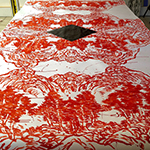
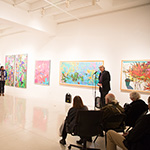
The University of California San Diego’s fine arts programs are ranked among the top in the nation. Department of Visual Arts lecturer Huai Li is among the many talented teachers who enhance that reputation and influence aspiring artists at the university. With a goal of engaging the greater San Diego community in her work—not unlike the university’s own efforts to reach beyond campus—Li is opening a solo exhibition titled “You Fascinate Me” March 11 at the Sparks Gallery in the Gaslamp Quarter in Downtown San Diego.
In the largest display of scholarship and creativity in visual arts at the university, UC San Diego Department of Visual Arts graduate students have organized two full days of programs designed to welcome the campus and community. The annual events known as the “Ph.D. Symposium” and the “Open Studios” highlight graduate student achievements. The programs take place Friday, March 3, 3:30 – 9 p.m. and Saturday, March 4, 9 a.m. – 7 p.m. in three campus locations: the University Art Gallery, the Structural and Materials Engineering Building and the Visual Arts Facility.
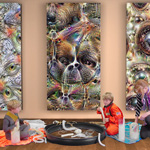
Arthur C. Clarke Center for Human Imagination showcases new video installation for an exhibition in Germany that opened on Feb. 11. Sci-fi author Bruce Sterling, who is affiliated with the Clarke Center, gave the opening talk at the “Hello, Robot” exhibition, and Clarke Center director Sheldon Brown led the team (including Sterling) that created the video installation “My Elegant Robot Freedom” on display in the new exhibition.
The University of California San Diego’s Program in Transnational Korean Studies will continue its Korean diaspora film series by offering audiences a rare opportunity to meet two award-winning film artists, Jane Jin Kaisen from Denmark (Feb. 9-10) and Heung-Soon Im from South Korea (Feb. 21-22). Highlighting the hidden stories of modern Korea, the series combines film, criticism and dialogue in an examination of transnational adoption, militarism, globalization and social protest. It also highlights the struggles and voices of women.
At recent celebratory receptions, more than 200 campus and community members paid tribute to the legacy of the late Harold Cohen, University of California San Diego Department of Visual Arts professor emeritus who passed away last year. Renowned for creating AARON, an artificial intelligence art-making machine, Cohen and his affiliated works are featured in an honorary exhibition entitled “Harold Cohen, Creating Computational Creativity.” It surveys 40 years of the vibrant and large-scale prints that demonstrate Cohen’s innovative process and invites dialogue about the role of the artist and art. The show runs at the University Art Gallery and in the Visual Arts Gallery in the Structural and Materials Engineering (SME) Building through Feb. 17, when it will conclude with a closing symposium, "Art and Artificial Intelligence (AI), After AARON." The symposium will feature leaders in contemporary art and AI from Google, UC Santa Barbara, UC San Diego and the Salk Institute.
The University of California San Diego’s Department of History encompasses major teaching and research fields that span the globe from the United States to Europe, Africa, Asia, Latin America and the Middle East. Across these geographic boundaries, the department offers thematic strengths in gender, sexuality, nationalism, race, ethnicity and even the afterlife.