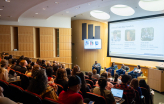
Experts in the field of mindfulness will gather in San Diego from Feb. 7-9 to share the latest advancements in education, clinical care and research as it applies to the healthy development of youth through the application of meditation. The experiential conference, sponsored by the UC San Diego School of Medicine and Center for Mindfulness, will offer a combination of more than 40 compelling lectures, research symposia and breakout sessions to a diverse audience of school educators, healthcare providers, psychotherapists, and researchers.
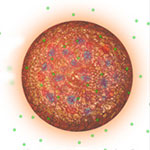
With the help of biomimetic matrices, a research team led by bioengineers at the University of California, San Diego has discovered exactly how calcium phosphate can coax stem cells to become bone-building cells. This work is published in the Proceedings of the National Academy of Sciences the week of Jan. 6, 2014.
Researchers at the University of California, San Diego School of Medicine report that an oncogene dubbed ROR1, found on chronic lymphocytic leukemia (CLL) B cells but not normal adult tissues, acts as an accelerant when combined with another oncogene, resulting in a faster-developing, more aggressive form of CLL in mice.
The interventional cardiology team led by Ehtisham Mahmud, MD, FACC, at UC San Diego Sulpizio Cardiovascular Center (SCVC) has successfully completed the first two robotically-assisted coronary angioplasty/stent procedures in California.
UC San Diego Sulpizio Cardiovascular Center (SCVC) has been featured in the latest Becker’s Hospital Review list of “100 Hospitals with Great Heart Programs.” Hospitals were selected based on quality care, clinical accolades and research contributions to the field of cardiovascular care.
Researchers at the University of California, San Diego School of Medicine, with colleagues in The Netherlands and United Kingdom, have produced the first map detailing the network of genetic interactions underlying the cellular response to ultraviolet (UV) radiation.