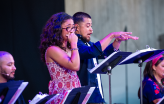
Composer Hilda Paredes used the Mayan calendar as the basis for her solo percussion piece, “Tzolkin,” with soft eerie pulses suggesting the passage of ancient time. In a sense, her music bridged the divide between modern Mexico and its poor indigenous communities. Paredes’ work, and other compositions from around the world, will be performed Feb. 26 – 28 at UC San Diego Department of Music’s Intercultural Music Conference (ICM). More than 80 composers, scholars and performers will present three days of lectures, concerts and panel discussions exploring music in our rapidly evolving intercultural landscape. They’ll consider music in the Middle East, Africa, Asia, Mexico and other locales. Concerts will showcase both traditional and contemporary music.
A biophysicist and an astrophysicist at UC San Diego have been named 2016 Cottrell Scholars, an award given this year to only two dozen scientists nationwide. Eva-Maria Schoetz Collins, an assistant professor of physics and biology, and Dusan Keres, an assistant professor of physics, will each receive $100,000 awards for research and teaching given annually to the top early career academic scientists by the Research Corporation for Science Advancement.
Inflammation is a Catch-22: the body needs it to eliminate invasive organisms and foreign irritants, but excessive inflammation can harm healthy cells, contributing to aging and sometimes leading to organ failure and death. Researchers at University of California, San Diego School of Medicine have discovered that a protein known as p62 acts as a molecular brake to keep inflammation in check and avoid collateral damage.
Delivering on the late astronaut Sally Ride’s pioneering spirit, UC San Diego today announced the official launch of Sally Ride Science at UC San Diego with a slate of summer workshops in science, technology, engineering, art and math, or STEAM, aimed at young women in middle school and high school.
A new cyber-archaeology research center in the Qualcomm Institute at UC San Diego has received data on 18,500 archaeological sites under a new partnership between the center and the Israel Antiques Authority.
This month’s announcement by the National Science Foundation that scientists for the first time detected gravitational waves in the universe as hypothesized by Albert Einstein 100 years ago has opened up a new era of exploration for astronomers and astrophysicists. The NSF-funded Comet supercomputer at the San Diego Supercomputer Center (SDSC) at the University of California, San Diego, which went into operation in May 2015, was one of several high-performance computers used by researchers to help confirm that landmark discovery before a formal announcement was made.