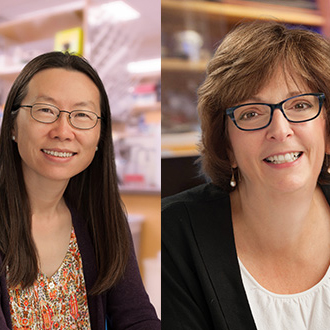
Scientists have long pondered how non-living materials coalesced into the earliest life forms on Earth. Nearly 60 years ago Stanley Miller and Harold Urey, founding professors of the physical sciences at the University of California San Diego, established a tradition of working to answer questions about life’s molecular origins. Professor Neal Devaraj continues that UC San Diego legacy by using chemistry to solve questions in biology, while also developing new tools that uniquely perform tasks within living cells. For his inventive work, the Blavatnik Family Foundation and the New York Academy of Sciences have announced Devaraj as the 2018 Blavatnik National Laureate in Chemistry.
Human activities—from growing rice and burning coal or wood, to driving cars and testing nuclear missiles—have impacted the Earth’s atmosphere over time. Cleansing the Earth’s environment is of growing interest in the new era of humanity, unofficially called the Anthropocene epoch. To better understand the impact of the human biogeochemical footprint on Earth, scientists at the University of California San Diego are literally climbing mountains to study the planet’s sulfur cycle—an agent in cardiovascular fitness and other human health benefits and resources.
In 2012, the popular UC San Diego Craft Center abruptly closed. Students, staff and faculty, who enjoyed a variety of non-credit classes and programs including ceramics and glass blowing to photography and weaving, were shocked and saddened. But the uproar from neighbors, who for decades also enjoyed the center that connected the campus and community, was surprising.
For the second year in a row, the London-based Times Higher Education ranked UC San Diego the world’s number one research university founded during the “golden age” of higher education development, in the two decades between 1945 and 1967—when higher education was characterized by rapid university expansion and increasing investment in research.
To begin to understand the field of plasmonics, picture the rich colors of stained glass windows in Gothic cathedrals; or, the pixelation of a digital photo on a laptop screen. In some way, shape or form these are plasmons on display. Basically, plasmons are traveling waves of rippling electrons that can be excited in plasmas, metals or semiconductors. They lie at the heart of plasmonics. In such systems, plasmons bunch up and spread out as a group, enhancing and manipulating electromagnetic energy and concentrating optical energy beyond the diffraction limit of light. But much of this energy in common materials is quickly lost, or dissipated, as heat. And, while plasmons have found commercial applications in chemical sensors (e.g., common drug-store pregnancy tests), they have not been applied more widely or ambitiously because of high dissipation, which has frustrated scientists—until now.
The race is on between new antibiotics and drug-resistant bacteria—and scientists are challenged to keep up. By 2050, according to a Wellcome Trust study, deaths from deadly infections will be more common than cancer deaths. Scientists report that currently antimicrobial resistance causes 23,000 deaths annually in the U.S.; 700,000 deaths worldwide. Better methods to treat bacterial infections are urgently needed. So researchers, including a University of California San Diego professor, are gaining ground by demonstrating the first example of an effective gene therapy for deadly bacterial infections.