

Using Personal Data to Predict Blood Pressure
Engineers at UC San Diego used wearable off-the-shelf technology and machine learning to predict an individual’s blood pressure and provide personalized recommendations to lower it based on this data.
Engineers at UC San Diego used wearable off-the-shelf technology and machine learning to predict an individual’s blood pressure and provide personalized recommendations to lower it based on this data.
A leading think tank dedicated to researching global security threats, located on the campus of the University of California San Diego has been awarded ongoing funding by the State of California. From finding ways to mitigate conflict through active dialogue on the Korean Peninsula, to exploring how to address the dangers of nuclear proliferation, such as training the next generation of nuclear policy experts, the Institute on Global Conflict and Cooperation (IGCC) works with all ten campus in the University of California (UC) system to address pressing and long-term international security concerns and policy challenges.
UC San Diego Department of Visual Arts artist Heejung Shin is awarded the inaugural David Antin Prize. Named after poet, artist and founding member of the department, the prize is given to a graduating MFA student who shows originality and creativity in art practice or criticism.
The University of California San Diego has been named the 30th best university in the world, out of the top 1,000 public and private universities spanning the globe. The 2019 Times Higher Education World University Rankings also place the campus 20th best in the U.S. based on teaching, research, knowledge transfer and international outlook. The campus moved up one spot, compared to last year.
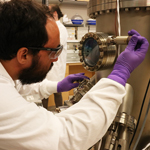
Like consumers investing in a pair of body-shaping jeans, the National Science Foundation (NSF) invests in basic research and people to mold the future. So, the government agency awarded more than $500,000 to the University of California San Diego and the University of Texas at San Antonio (UTSA) to study, for the first time, the exploration of the electronic and magnetic behavior of one-dimensional (1D) metallic chains. In this case, these are ultra-short chains of atoms that can be fabricated using organic molecules called metallo-phthalocyanine (MPc)—flat molecules with a metal atom at the center commonly used in dyes present in the color of blue denim. The findings could lead to the development of new, smaller and faster electronic devices that can be used in computer memories, as well as to promising careers for future scientists.
The words “fly like an eagle” are famously part of a song, but they may also be words that make some scientists scratch their heads. Especially when it comes to soaring birds like eagles, falcons and hawks, who seem to ascend to great heights over hills, canyons and mountain tops with ease. Scientists realize that upward currents of warm air assist the birds in their flight, but they don’t how the birds find and navigate these thermal plumes.
Keep up with all the latest from UC San Diego. Subscribe to the newsletter today.