These Engineers Are Working on a Better Asteroid Warning System
Published Date
Story by:
Media contact:
Share This:
Article Content
Despite all the excitement Hollywood offers with blockbuster films about saving Earth from disasters like asteroids, the truth is that saving the planet in those scenarios involves math. A lot of math.
Fortunately, Jacobs School of Engineering researchers such as professors Thomas Bewley and Aaron Rosengren, and doctoral student Benjamin Hanson, are at the forefront of protecting us from this kind of potential disaster. The three mechanical and aerospace engineers are working on predictive models that assess the risk of a large meteorite making it through Earth’s atmosphere intact and hitting the ground.
Asteroids (larger than 3 feet in diameter) and meteoroids (smaller than 3 feet in diameter) are chunks of rock and metal that orbit the sun, just like planets. When either breach our atmosphere but are small enough to burn up in that process, they are called meteors — or shooting stars. But when a chunk of rock is large enough that part of it passes through the atmosphere, its surviving pieces are called meteorites.
It is the larger asteroids — and the meteorites they produce — that UC San Diego researchers are concerned with. Depending on the size of a meteorite, it could be a catastrophic event for life on Earth. NASA estimates that 48.5 tons of meteoric material — thankfully mostly as fine dust and small particles — falls on Earth every day.
“We use detailed computer simulations to help us understand which objects are harmless background traffic and which ones might one day require action,” Rosengren says. “Even when the chance of any single impact is tiny, the consequences of being wrong about a large object can be enormous.”
The raw information that Bewley, Rosengren and others work with comes from a worldwide effort including observatories as well as amateur astronomers who continually scan the night sky to find moving objects. That information is passed along to the Minor Planet Center, a global clearinghouse that links observations together and estimates preliminary orbits.
In 2024, an asteroid dubbed Asteroid 2024 YR4 was discovered. Estimated to have a diameter of between 174 and 220 feet, it is roughly the size of a 15-story building, according to NASA. Or, in other words, it’s a giant space rock that would dwarf the iconic Lincoln Memorial in Washington, D.C., if it were sitting next to it.
“Fortunately, based on our very accurate simulations, we now know with near certainty that YR4 is not going to hit the Earth in 2032,” Bewley says. However, if something of that size were to hit Earth, he says, “the impact would be roughly equivalent to 500 times the energy of the Hiroshima bomb — and depending on exactly where it hit, that could devastate an entire country.”
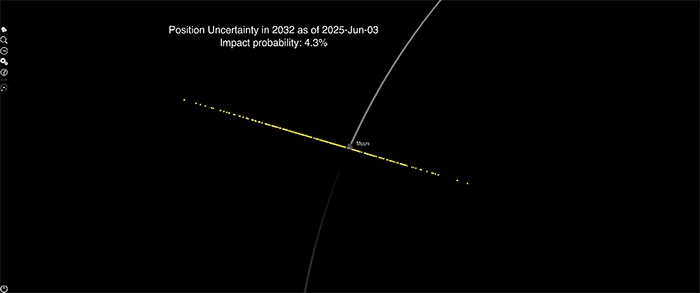
Animation of asteroid 2024 YR4’s potential locations on December 22, 2032. The animation demonstrates how the additional data from the February 2026 James Webb Space Telescope observations have increased the certainty of where the asteroid will be in the future and decreased the range of possible locations. With this new data, 2024 YR4 is expected to pass by the Moon at a distance of 13,200 miles (21,200 km) and lunar impact is no longer a possibility.
Photo: NASA/JPL Center for Near-Earth Object Studies
Photo: NASA/JPL Center for Near-Earth Object Studies
Meteorite hits on Earth have happened in the past, including at a still-visible 3,900-foot wide, 560-foot deep crater in the Arizona desert. This is why the work to predict the path of asteroid orbits is so important for protecting human lives.
The good news is that researchers are able to run probabilities of impact far in advance of a potential collision between an asteroid and the Earth. “For the class of objects we worry most about from a planetary-defense standpoint — hundreds of meters across — a realistic goal is to have at least 5 to 10 years of warning,” Rosengren notes.
“That sounds like a long time, but in engineering terms it is barely enough,” Rosengren adds.
And here’s where Hollywood comes in again. Much like a movie, counteracting the threat would involve spacecraft and missions to “nudge” the asteroid off its collision course with Earth. But that could happen only if there’s enough time to detect the threat and design, fund and launch a spacecraft and reach the asteroid, Rosengren explains.
If a dangerous object was discovered within only a couple of years, or — even worse — months or days ahead of a potential collision, “the response would need to shift from deflection to civil protection,” Rosengren says. “We would need to predict where the impact would occur, then warn and evacuate populations if possible, and protect critical infrastructure.”
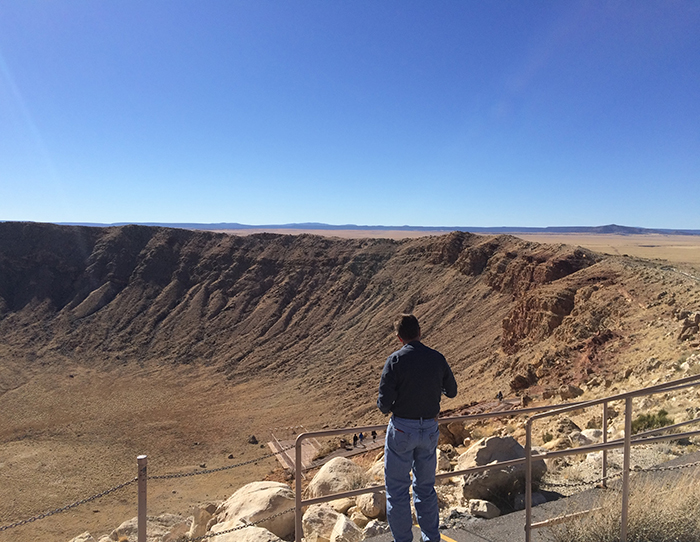
Meteor Crater in Arizona -- 3,900-foot wide and 560-foot deep -- was created about 50,000 years ago by a 160-foot meteorite.
Photo: Ioana Patringenaru/University of California San Diego
Photo: Ioana Patringenaru/University of California San Diego
This is why it’s important that scans of the night sky are conducted so rigorously, and all new findings are carefully plotted and assessed by Bewley, Rosengren, Hanson and others.
“What we at UC San Diego have done is pioneered the estimation of potentially catastrophic, highly unlikely events into the next 5 or 10 years,” Bewley says. “By doing so, we can anticipate which things we really need to be concerned about and potentially do something about in order to prevent a collision.”
Who says math is boring?
Share This:




Stay in the Know
Keep up with all the latest from UC San Diego. Subscribe to the newsletter today.
