Safer Railroads Through Ultrasound
Advances in ultrasonic imaging technology and beamforming algorithms enable real-time flaw detection inside railroad tracks to prevent derailments

Published Date
Story by:


Topics covered:
Share This:
Article Content
Advances in ultrasound — the same imaging technology that uses sound waves to allow doctors to monitor babies in utero — are being applied by engineers at the University of California San Diego to make railroad track inspection more effective. Ensuring the safety of the vast 140,000-mile network of existing rail infrastructure in the United States is critical, especially as that figure grows with the addition of new high-speed passenger rail lines.
Partnering with industry and government railroad organizations, structural engineers at UC San Diego applied an innovative form of ultrasound with new beamforming algorithms to create a device that can be embedded in the wheel of a cart — and one day, potentially a train itself — to inspect each and every mile of rail for defects and internal cracks not visible to the naked eye. These internal fractures and fissures, if not detected or monitored, can break under the weight of a train, with the potential for service disruption and loss of productivity.
The device provides real-time high-resolution images of any internal defects as the cart is pushed over a railroad track. This is an improvement from the current state-of-the-art. Currently, ultrasonic rail test vehicles that are part of the Federal Railroad Administration’s Automated Track Inspection Program move at speeds of roughly 25 miles per hour over the track, detecting areas where there may be internal anomalies. Then, inspectors manually check those flagged areas using a handheld ultrasound flaw detector that produces the waveform (A-scan signal) of the ultrasound.
This new device produces actual images of internal flaws, not just the ultrasound waveform, meaning a much clearer picture of the type and location of defects inside the railroad track. It can also be used at walking speed, making it possible to achieve higher quality information at a much faster pace than current methods.
This latest advance is the result of more than two decades of research by a team of structural engineers in the lab of Francesco Lanza di Scalea, a professor in the Department of Structural Engineering at the UC San Diego Jacobs School of Engineering. He also serves on two key rail engineering committees of the Transportation Research Board of the National Academies and is a Fellow of multiple professional societies. This research at UC San Diego has been supported in the past by the Federal Railroad Administration, and is currently funded by MxV Rail, Inc., a wholly-owned subsidiary of the Association of American Railroads (AAR) through the AAR Strategic Research Initiative (SRI) program. The AAR is an industry trade group representing the major rail companies in the United States.
“Early and accurate detection of internal anomalies in rails is of paramount importance to ensure safety of rail transportation,” said Lanza di Scalea. “Hundreds of service failures occur every year in the U.S. alone are caused by undetected rail flaws. UC San Diego has taken a leading role in this research for many years, working to improve the state of the art of rail inspections on several fronts.”
The researchers demonstrated this technology at MxV Rail’s purpose-built Colorado research facility in August 2025 during University Days. The team is now working with MxV Rail researchers to determine the most cost-effective configuration for field deployment and to carry out extensive validation testing in Colorado.
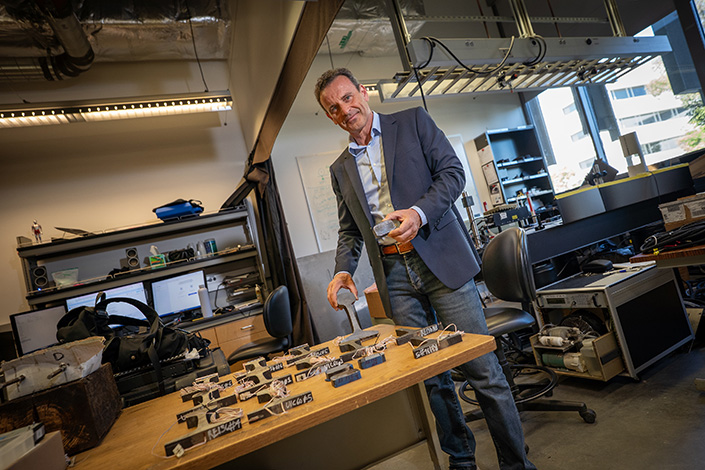
Lanza di Scalea has led pioneering work in non-destructive testing, particularly for railroads, for several decades. For example, his lab performed materials characterization tests on different types of railroad ties, pictured here, for the California High Speed Rail authority.
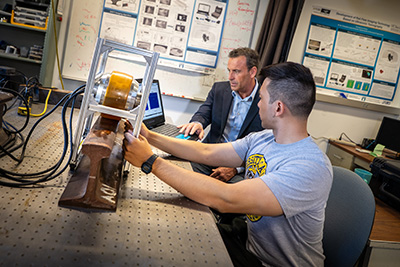
The researchers' ultrasound probe is small enough to fit inside the wheel of a cart as it drives over railroad tracks, but powerful enough to produce real-time high-resolution images of any defects inside the track.
High-quality images, at speed
“Our goal was to enable this ultrasonic inspection device to provide the user with real-time images and move as quickly as possible without losing signal strength,” said Chengyang Huang, a postdoctoral scholar in Lanza di Scalea’s lab, whose work on beamform algorithms was crucial to enabling the real-time images. “It’s always an engineering tradeoff — if you go faster, you lose signal. A key piece of our research with this device was how we can still interpret the signals and get a good quality image from inside the rail track, in real time, even at higher speeds.”
The researchers were able to overcome the tradeoff between image quality and speed by combining the best elements of two different types of ultrasound — phased array and synthetic aperture focused ultrasound.
Existing defect detection tools using ultrasound rely on phased array ultrasound. In this method, many transducers are pointed in the same direction to generate an image of that specific area. This results in great signal strength because the beam is physically focused, but requires expensive multiplexer hardware, which can also be bulky.
In contrast, sparse synthetic aperture focused ultrasound uses a single transducer without any multiplexing, offloading the process of directing the ultrasound waves to a certain location — called beamforming — to algorithms instead of electronics. This approach can cover a much broader area with higher effective resolution than a fixed phased array, while significantly simplifying the hardware required and therefore lowering the cost. However, it does not always produce the same signal strength as the phased array method.
The UC San Diego researchers devised a hybrid version by firing a subarray instead of just one transducer array, offloading some of the multiplexing required in phased array ultrasound to the beamforming algorithms used in synthetic aperture focused methods. By simplifying the hardware and making the software carry the load, this method provides both signal strength and high-resolution images. It allows the researchers’ device to be low-cost and compact enough to fit inside a small wheel, while maintaining strong, high-resolution images at fast speeds.
Another key to making their new tool usable for industry partners was an ultrasound video processing technique that removes unwanted artifacts from the synthetic aperture images. These images are actually beamformed as videos that can sometimes contain reflections from the wheel or the track surface or other unwanted artifacts that obscure true defects. Using an unsupervised machine learning method they developed called physics-driven SVD filtering, the tool removes these unwanted artifacts, so that only any rail defects are shown. This recently published advance can also be applied to other fields requiring video-based sensing, including optics and thermal imaging.
Safer structures, in rail and beyond
Now, the researchers are working with MxV Rail to continue to improve their prototype for rail carriers such as BNSF, Amtrak and Union Pacific. As they continue to improve the ability to generate high quality, real-time images at speed, they hope to one day be able to embed a similar device inside future smart sensing trains for passive and accurate monitoring of railroad tracks and ties.
Applications of this imaging technology don’t end with trains. This research is also being applied to non-destructive monitoring in the maritime and aviation industries. For example, the team has adapted the hybrid imaging approach to inspect complex composite aircraft panels using simple, low-cost hardware, drawing on recent advancements in wave physics and signal processing techniques.
This latest device builds off several decades of work by researchers in Lanza di Scalea’s lab, developing a variety of methods to non-destructively monitor and assess the integrity of structures from railroads to bridges to energy infrastructure and even airplanes.
Their advances have been used to help the U.S. military better detect hidden roadside explosives; perform ultrasound imaging inspection on odd-shaped structures such as wind turbines or engine parts; and non-destructively ensure airplane components are structurally sound.
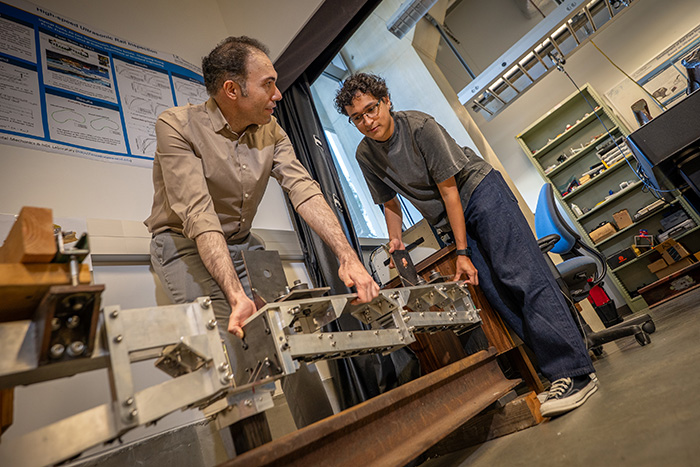
Graduate students Ali Hosseinzadeh and David Hernandez display another rail safety device the Lanza di Scalea lab has been developing for high speed rail inspection. This ultrasound sensor would be mounted under a train to flag potential internal anomalies for further inspection. Current versions of this type of sensor work at speeds of around 25 miles per hour. The Lanza di Scalea lab is working to enable a sensor that would work at speeds of 60 miles per hour, to create a truly smart train.




Stay in the Know
Keep up with all the latest from UC San Diego. Subscribe to the newsletter today.
