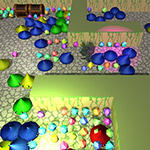
Somewhere in the at-risk ruins of Khirbat en-Nahas in the Faynan region of southern Jordan lie untold stories of copper mining and smelting industries from the time of David and Solomon and the Edomite kings. Stories that, until now, could only be told in words, maps and photographs. Thanks to UC San Diego engineering and archaeology students that teamed up for the world’s first cyber-archaeology hackathon, the story of King Solomon’s copper mines now exists in virtual reality.
Rock star drummer Rikki Rockett feels very lucky to be on tour with his band, Poison. A year ago, he didn’t know if he would survive tongue cancer but after participating in an immunotherapy clinical trial at Moores Cancer Center at UC San Diego Health, he was declared cancer-free in July 2016. To give back, Rockett is now asking concert-goers to join him in supporting immunotherapy at Moores Cancer Center.
By applying a novel computer algorithm to closely mimic how the brain learns, a team of researchers – with the aid of the Comet supercomputer based at the San Diego Supercomputer Center (SDSC) at UC San Diego – has identified and replicated neural circuitry that resembles the way an unimpaired brain controls limb movement.
San Diego-area high school students interested in pursuing a career in scientifically-based research are invited to apply to UC San Diego’s Mentor Assistance Program (MAP), a campus-wide initiative designed to engage students in a mentoring relationship with an expert from a vast array of disciplines.
A partnership between computer scientists at the University of California San Diego and Google has allowed the search giant to reduce by 70 percent fraudulent business listings in Google Maps. The researchers worked together to analyze more than 100,000 fraudulent listings to determine how scammers had been able to avoid detection—albeit for a limited amount of time—and how they made money.
Philip Guo caught the coding bug in high school, at a fairly typical age for a Millennial. Less typical is that the UC San Diego cognitive scientist is now eager to share his passion for programming with adults age 60 and up. His paper, the first known study of older adults learning to program, has been selected for honorable mention by a leading human-computer interaction conference called CHI.