How Healthy Stem Cells Turn Into Oral Cancer
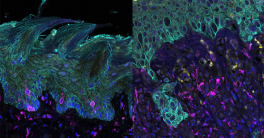
UC San Diego researchers have identified the molecular and cellular mechanisms that transform healthy stem cells into oral cancer at the earliest stages of the disease.
UC San Diego researchers have identified the molecular and cellular mechanisms that transform healthy stem cells into oral cancer at the earliest stages of the disease.
An international team of marine biologists has documented the highest known count of deep-sea species living in methane seeps off Costa Rica’s Pacific coast. A new study led by UC San Diego's Scripps Institution of Oceanography catalogues 488 distinct species found in these deep-sea ecosystems.
Scientists in UC San Diego’s School of Biological Sciences recently investigated how declining biodiversity in tiny ecological systems unseen to the naked eye can carry significant consequences for the health of organisms and ecosystems.
The University of California San Diego is positioning itself as a leader in astronomical research as its new Department of Astronomy and Astrophysics is building a world-class program for faculty-scholars and students.
As humankind imagines living off-planet — on the moon, Mars and beyond — the question of how to sustain life revolves around the physical necessities of oxygen, food and water. We know there is water on the moon, but how do we find it? Researchers from UC San Diego may help bring science fiction to reality by providing a divining rod to guide future space missions. Their work appears in a special issue of Proceedings of the National Academy of Sciences called “Water on the Moon and Mars,” which features Artemis I on its cover.
The devastating fires in Los Angeles have numerous secondary effects as scientists are finding out now off the coast of Southern California.
Keep up with all the latest from UC San Diego. Subscribe to the newsletter today.