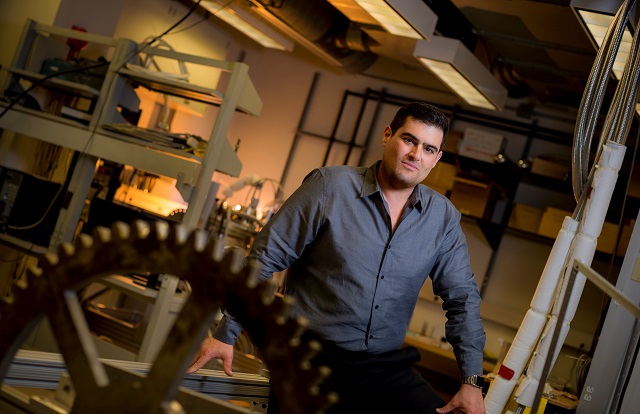
A faster collision detection algorithm could enable robots to work more fluidly in the operating room or at home for assisted living. The algorithm, dubbed “Fastron,” runs up to 8 times faster than existing collision detection algorithms. It uses machine learning to help robots avoid moving objects and weave through complex, rapidly changing environments in real time.
Now, Salk and University of California San Diego scientists have discovered that the fruit fly brain has an elegant and efficient method of performing similarity searches. For flies, it helps them identify odors that are most similar to those they’ve encountered before, so they know how to behave in response to the odor, such as to approach or avoid it. New details on the fly’s computational approach to smelly similarity searches, described in the journal Science on November 9, 2017, could inform computer algorithms of the future.
Two years after University of California President Janet Napolitano and Gov. Jerry Brown met here with scientists and legislators to set the UC system on its path to become carbon neutral by 2025, many of the details of how to accomplish that ambitious goal still need to be worked out.
The National Science Foundation has awarded $2.8 million to the University of California San Diego to construct a replica ocean-atmosphere system on the Scripps Institution of Oceanography campus. The new Scripps Ocean Atmosphere Research Simulator will mimic the ocean with unprecedented accuracy, capturing the interactions of wind, waves, microbial marine life, and chemistry at the sea surface in a laboratory setting.
Chronic inflammation is known to drive many cancers, especially liver cancer. Researchers have long thought that’s because inflammation directly affects cancer cells, stimulating their division and protecting them from cell death. But University of California San Diego School of Medicine researchers have now found that chronic liver inflammation also promotes cancer by suppressing immunosurveillance — a natural defense mechanism in which it’s thought the immune system suppresses cancer development.
Researchers at the University of California San Diego studying how animals respond to infections have found a new pathway that may help in tolerating stressors that damage proteins. Naming the pathway the Intracellular Pathogen Response, or “IPR,” the scientists say it is a newly discovered way for animals to cope with certain types of stress and attacks, including heat shock.