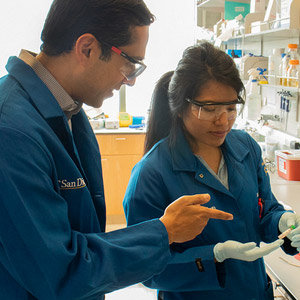
MIT Technology Review has named Sheng Xu, a professor of nanoengineering at the University of California San Diego, as one of this year’s top innovators under 35. Xu is being recognized for inventing a clever way to make off-the-shelf electronics stretchable.
Could nuclear power make a significant contribution to decarbonizing the U.S. energy system over the next three or four decades? The answer: probably not and that’s cause for major concern, according to a recently published paper in the Proceedings of the National Academy of Science (PNAS).
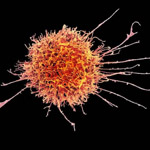
Emerging CAR-T immunotherapies leverage modified versions of patient’s T-cells to target and kill cancer cells. In a new study, researchers at University of California San Diego School of Medicine and University of Minnesota report that similarly modified natural killer (NK) cells derived from human induced pluripotent stem cells (iPSCs) also displayed heightened activity against a mouse model of ovarian cancer.
PET plastic, short for polyethylene terephthalate, is the fourth most-produced plastic, used to make things such as beverage bottles and carpets, most of which are not being recycled. Some scientists are hoping to change that, using supercomputers to engineer an enzyme that breaks down PET. They say it's a step on a long road toward recycling PET and other plastics into commercially valuable materials at industrial scale.
Scientists have long pondered how non-living materials coalesced into the earliest life forms on Earth. Nearly 60 years ago Stanley Miller and Harold Urey, founding professors of the physical sciences at the University of California San Diego, established a tradition of working to answer questions about life’s molecular origins. Professor Neal Devaraj continues that UC San Diego legacy by using chemistry to solve questions in biology, while also developing new tools that uniquely perform tasks within living cells. For his inventive work, the Blavatnik Family Foundation and the New York Academy of Sciences have announced Devaraj as the 2018 Blavatnik National Laureate in Chemistry.
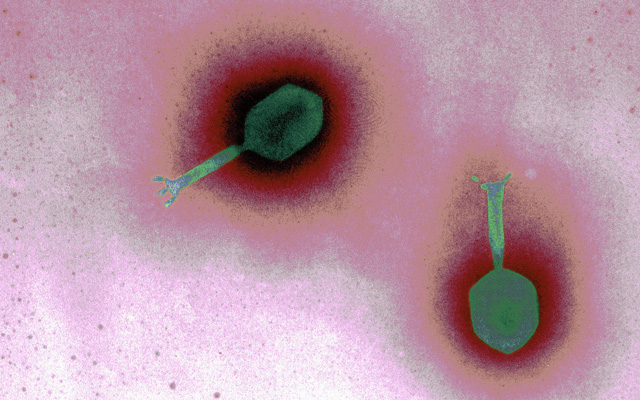
With microbial resistance to antibiotics growing into a major global health crisis, researchers at University of California San Diego School of Medicine, in collaboration with national research institutions and private industry, are leveraging hard-won expertise to exploit a natural viral enemy of pathogenic bacteria, creating North America’s first Center for Innovative Phage Applications and Therapeutics (IPATH).