The Heart of Healing
Celebrating the next generation of physicians at annual White Coat Ceremony
Published Date
Article Content
With the symbolic donning of their first white coats, the newest class of medical students at University of California San Diego School of Medicine marked the beginning of their journeys as future physicians. Surrounded by family, friends and faculty, they embraced not only a cherished tradition but also the responsibility to carry forward the heart of healing, grounded in compassion, dedication and service to others.
“This moment marks an extraordinary milestone in your journey, and I want to offer my heartfelt congratulations on choosing the medical profession.” Barbara Jung, M.D., associate vice chancellor and dean for UC San Diego School of Medicine told the students. “As I reflect on what it means to be a physician, I am reminded of the profound impact doctors have on the lives of their patients. Medicine is not simply a profession—it is a calling. It is a calling to heal, to comfort and to advocate for those in need.”

Allison Newell (left) and Kylie Joe (right) are the inaugural cohort of students in the newly developed Compassion in Medicine Academic Concentration (CIMAC).
This year’s class of 140 students includes two students who will complete a specialized academic track focused specifically on compassion and empathy. Kylie Joe and Allison Newell are proud to be the inaugural Tan Family Scholars who receive scholarship funding and have been selected to enroll in the newly developed Compassion in Medicine Academic Concentration (CIMAC). As part of their journey, they will complete the core medical school curriculum, in addition to elective coursework, research and global collaboration that emphasizes a specialization in compassion, empathy, leadership and the dissemination of what they learn to a broader audience in medicine.
“I was drawn to the CIMAC because it embodies the reason I chose medicine, to make a meaningful difference in people's lives through compassionate, empathetic care,” said Newell, who studied biochemistry at California State University San Marcos. “I hope to integrate these values into my career path, aiming to understand and build relationships with the person behind each patient. This program will equip me with the tools necessary to build a culture of empathy and compassion in my own future practice and the leadership skills to be a part of positive changes in the medical field as a whole.”
For Joe, who studied physiological science with a minor in public health at University of California Los Angeles, this specialized track will help her address the needs of those in her community. “Concentrating on compassion in medicine means committing to learning the stories of my patients outside of their diseases and to the depth of their passions, interests and history,” Joe said. “Treating patients with compassion will allow me to heal not just on a physical level but with a holistic perspective.”

Sriram Ambadi applied to medical school to continue a lifelong commitment to serving others.
As Sriram Ambadi, first-year medical student, reflected on how he came to School of Medicine, he noted that his path has been grounded in service. A lifetime of volunteer experiences taught him that compassion is about attentiveness.
“It’s not always a grand gesture, it is often the quiet moments,” said Ambadi, who studied anthropology and human biology at Emory University. “Compassion in medicine means seeing the human first, before the diagnosis. It’s remembering that your patient’s life doesn’t start and end at the hospital doors. They are someone’s parent, sibling, caretaker or friend. Sometimes they’re scared. Sometimes they’re silent. And often, they’re trusting you with the most vulnerable pieces of themselves. That trust deserves presence, patience and dignity.”


Michelle Daniel, M.D., vice dean for medical education, reminded the students of the history of the white coat and how it has changed the story of medicine from resignation to hope.
“Once, physicians wore black, cloaked in solemnity, walking beside patients when little could be done,” Daniel said. “But in the late 1800s, a shift began. Physicians turned to white, the white of laboratories, of discovery and of healing. The white coat also became something more than professional attire. It became a public statement—a visible sign of accountability. Wearing white signaled a promise not just to one patient at a time, but to entire communities. A promise to do better, to be better, to act with integrity and purpose.”
For first-year medical student, Erick Regalado, he knows already that his purpose is to help people. A high school best friend’s medical diagnosis highlighted a sense of helplessness that inspired him to learn more and put himself in a position to help others facing similar circumstances.
“My parents immigrated from Mexico to Las Vegas, Nevada, where I was born and raised. I grew up in an underserved community and attended public schools in a district that ranked low nationally,” said Regalado, who studied neuroscience at the University of Nevada, Reno. “Growing up, I saw how mental health was often disregarded in Mexican culture, and how Latino families like mine frequently had limited access to medical resources and language-concordant care. These experiences made me realize how much of a difference a physician who understands both the science and the culture can make.”

Erick Regalado says that he aspires to be a physician who brings humanity into every interaction, no matter the circumstances.
Entering Class Statistics
|
|
- Top majors: Biology, Neuroscience, Molecular & Cell Biology
- Unique majors: Spanish Literature and Culture; International Development Studies; International Relations; History of Science, Medicine, and Public Health

The stethoscopes that each student received were generously donated by alumni, donors and the Sanford Institute of Empathy and Compassion.
Humanity and Compassion
In addition to welcoming the newest class of medical students into the profession, the White Coat Ceremony honors fourth-year medical students, trainees and faculty who exemplify humanism in medicine. The Gold Humanism Honor Society (GHHS), a national organization, affirms the essential role of compassion in health care. By recognizing those who prioritize human connection in their practice, GHHS builds a community dedicated to championing and advancing compassionate patient care.
Jess Mandel, M.D., Kenneth M. Moser Professor of Medicine, chief for the Division of Pulmonary, Critical Care, and Sleep Medicine and executive vice chair for the Department of Internal Medicine, received the Leonard Tow Humanism in Medicine Award presented by the Arthur P. Gold Foundation, which includes induction into the GHHS. Awarded annually to a School of Medicine faculty member who best exemplifies humanism in medicine, the recipient of this award is nominated by medical students and faculty and selected by a committee of peer faculty members.
As he addressed the newest class of medical students, he reminded them that their lives will forever change after donning their white coats.
“A life in medicine shapes not just your patients, but you as well. By practicing with courage, humility and wisdom, you build what Dr. Tinsley Harrison called an ‘enduring edifice of character.’ This growth — deepening your empathy and compassion — is as vital as growing your medical knowledge base over the course of your career. Embrace this growth, and it will enrich both your patients’ lives and your own.”
For the student and trainee inductees, the GHHS solidifies their commitment to becoming compassionate and empathic physicians.
Gold Humanism Society Class of 2026 Inductees:
Madison Alexander, Evan Ashcraft, Alec Calac, Paulina Cedillo, Karyssa Domingo, Savannah Fakhouri, Aidan Galati, Celeste Hsu, Mohamman Nour Hussari, Maya Kalbag, Sidney Lin, Zoe Matticks, Sadie Munter, Kelsey Plambeck, Austin Powell, Yasoda Satpathy, Diana Smith, Eli Solomon, Lauren Wedekind
Resident Physician Inductees:
Justin Creeden, M.D., Ph.D., Department of Psychiatry; Jonathan Hong, M.D., Departments of Medicine & Pediatrics; Yasamin Mohammadi, D.O., Department of Pediatrics; Grace Noonan, M.D., Department of Obstetrics, Gynecology and Reproductive Sciences; Louis Perkins, M.D., Department of Surgery and David Vo, M.D., Department of Neurosciences.

Michelle Daniel, M.D. presented Jess Mandel, M.D. with the Leonard Tow Humanism in Medicine Award.

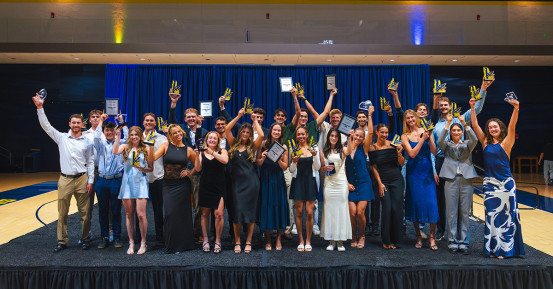
After being recognized, the Gold Humanism Honor Society inductees recite an oath as part of their induction ceremony.
As the 2025 entering class, the medical students thus begin their journey in medicine, they were reminded that each new white coat is more than a symbol. It is a promise to keep the heart of healing at the center of the care they provide.
“You are now part of a remarkable community. From day one, I knew I was in the right place for me, and I hope you feel that same sense of belonging and purpose here at UC San Diego.”
- Jeffrey Krebs, M.D. ’86, president of the UC San Diego Medical Alumni Association

Congratulations, Class of 2029!
Share This:



Stay in the Know
Keep up with all the latest from UC San Diego. Subscribe to the newsletter today.
