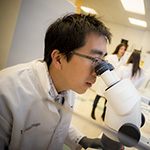
Every day, every inch of skin on your body comes into contact with thousands of molecules — from food, cosmetics, sweat, the microbes that call your skin home. Now researchers can create interactive 3D maps that show where each molecule lingers on your body, thanks to a new method developed by University of California San Diego and European Molecular Biology Laboratory (EMBL) researchers. The technique is published December 21 in Nature Protocols.
Thirty two faculty members at the University of California San Diego are among the world’s most influential researchers in their fields, based on their publications over the past decade.
UC San Diego professors Michael Burkart, Catherine Constable, Richard Gallo, William Gerwick, Miroslav Krstic and Lorraine Pillus have been awarded the distinction of fellow by the American Association for the Advancement of Science (AAAS), the largest general science organization in the United States and publisher of the journal Science.
Understanding the control of cell growth has challenged biomedical researchers for decades. Efforts to meet this challenge may have received an encouraging boost, however, from University of California San Diego physics professor Terence Hwa and colleagues. Their research, published in the Oct. 25 issue of Nature, led to the surprising discovery of a mathematical equation governing the control of cell growth.
The University of California San Diego has been named the globe’s 16th best university by U.S. News and World Report. The campus was also recognized as the nation’s 5th best public university in the fourth annual rankings, which measure factors such as research, global and regional reputation; international collaboration; as well as the number of highly-cited papers and doctorates awarded.
University of California San Diego researchers have developed the first 3D spatial visualization tool for mapping “’omics” data onto whole organs. The tool helps researchers and clinicians understand the effects of chemicals, such as microbial metabolites and medications, on a diseased organ in the context of microbes that also inhabit the region. The work could advance targeted drug delivery for cystic fibrosis and other conditions where medications are unable to penetrate.