Well Worn
Sensors on the skin, such as electrode-equipped temporary tattoos or patches that emit ultrasound waves, promise a future of on-the-spot, on-the-go health monitoring.
Story by:
Published Date
Story by:
Topics covered:
Share This:
Article Content
When you hear the word "wearables," devices such as smartwatches or Fitbits most likely come to mind. These wearables have become a part of everyday life, allowing you to, among things, count calories and steps, monitor heart rate and track sleep quality — all on your wrist. But what if a whole new world of health-related services was within reach?
At the UC San Diego Center for Wearable Sensors, engineers and clinicians are coming together to develop a new generation of wearables that can do so much more than those at hand.
They are creating advanced technologies and systems that will allow people to monitor individual health conditions at home and on the go, without consciously thinking about it. These wearables don’t look anything like today’s electronic gadgets. They are soft, stretchy, incredibly thin and lightweight, similar to a Band-Aid but sturdy enough to cope with the wear and tear of everyday use.
“Our goal is to help people get information about their health, fitness and medical status anytime, anywhere, simply by wearing a stamp-sized patch on the surface of the skin,” said Joseph Wang, PhD, professor of nanoengineering at UC San Diego Jacobs School of Engineering and director of the Center for Wearable Sensors.
“Our vision is to make wearable devices that are so unobtrusive, so invisible that users are virtually unaware that they’re wearing them,” added center co-director Patrick Mercier, PhD, professor of electrical and computer engineering. “These ‘unawareables’ can be seamlessly integrated into daily life to acquire useful health data and users won’t have to do anything.”
Achieving these goals is made possible by interdisciplinary partnerships across campus.
“Our collaborations with medical researchers and clinicians have given us invaluable insight to better tailor and translate these wearables for clinical use,” said Wang.
Needle-free glucose monitoring
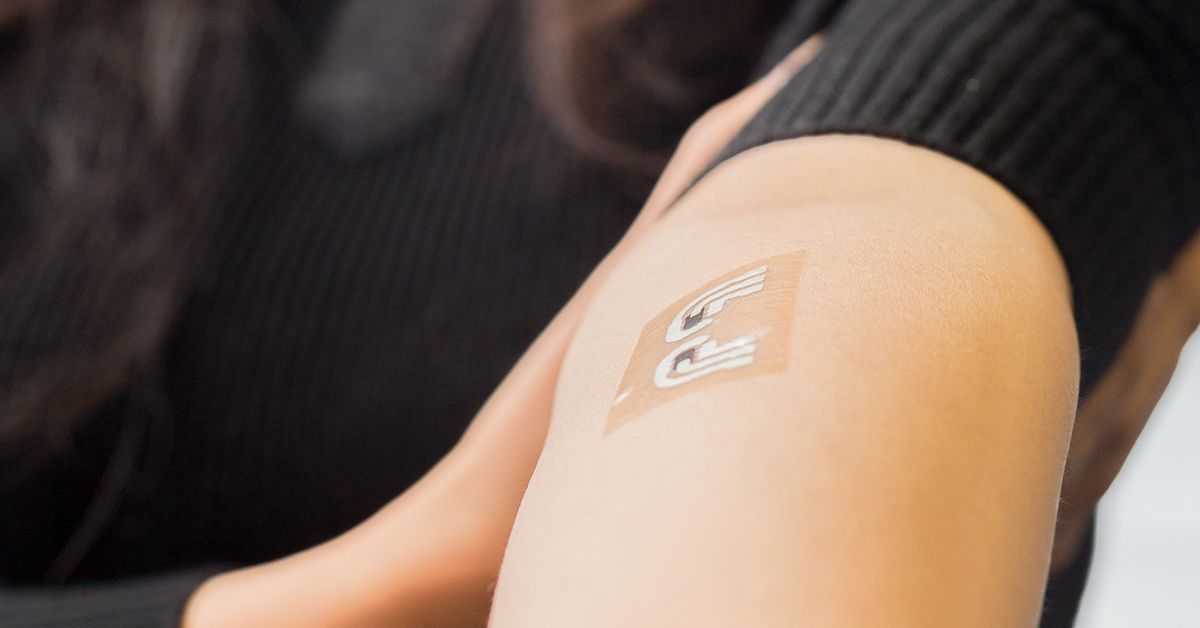
One wearable making the leap from lab to real-world use is a temporary tattoo that serves as a glucose monitor. Developed by a team of engineers led by Wang and Mercier, the tattoo offers diabetes patients a way to test their blood glucose (blood sugar) levels without the traditional needle-prick.
“Drawing blood is uncomfortable. No one likes doing it. The beauty of this technology is that it is a truly noninvasive means to measure glucose over the course of the day,” said Mercier. “By giving this real-time information to patients, they can manage their consumption of sugars and injections of insulin much better than with periodic spot measurements.”
An estimated 37 million people in the United States live with diabetes. Monitoring blood glucose levels is integral to managing their condition. Currently, patients must produce a drop or two of blood from a fingertip needle-prick multiple times per day to analyze glucose levels. Continuous glucose monitors exist, but they require inserting a needle into the abdomen or arm. Many patients avoid testing or do not do it regularly because they find it unpleasant or difficult to perform. According to Edward Chao, DO, clinical professor of medicine at UC San Diego School of Medicine and a physician at VA San Diego Healthcare System, one-quarter of persons receiving insulin treatment either infrequently or never test their blood glucose. Another 65 percent who use other drugs to treat diabetes test just once a month or less.
“Adherence to chronic disease management is typically low — about 50 percent. Diabetes is no exception,” said Chao. “And there’s a lot more self-management involved in diabetes beyond using needles to test blood glucose. A tool like the glucose-monitoring tattoo can reduce discomfort or inconvenience to increase vital monitoring.”
The tattoo is worn just like a kid’s temporary tattoo: Applied to the skin with a dab of water and the backing peeled away. The tattoo contains two electrodes that apply a minute and imperceptible electrical current, generated by a small, low-power electronic circuit that connects to the tattoo. The current forces fluid between skin cells, called interstitial fluid, to rise to the surface, carrying glucose molecules along with it. A sensor in the tattoo measures the strength of the electrical charge produced by glucose to determine a person’s overall glucose level.
The tattoo recently completed a Phase I clinical trial, headed by Chao, in collaboration with Wang and Mercier. The study, which took place at UC San Diego Altman Clinical and Translational Research Institute, validated the device’s accuracy at detecting glucose levels compared to a traditional glucometer.
The study consisted of a small group individuals with diabetes. Each individual wore a tattoo and had their glucose levels checked after a period of fasting, and then multiple times every couple of hours after eating. The tattoo’s readings were similarto results from simultaneous finger-prick glucose readings.
The research team is now refining the technology for continuous glucose monitoring, and planning for a larger second trial.
“Reactions to this technology have overall been enthusiastic,” said Chao. “There can be this perception of technology being impersonal or requiring specialized knowledge to use. With a wearable like this, we have a way to personalize technology, make it more accessible and less intimidating, and even encourage patient engagement.”
Sensing deeper with ultrasound
Wearables have the potential to change not just how patients manage chronic disease, but also how clinicians treat those patients.
Sheng Xu, PhD, professor of nanoengineering, seeks to develop wearables that go beyond what other devices can measure. “Wearable devices have so far been limited to sensing signals either on the surface of the skin or right beneath it,” he said. “But this is basically just scratching the surface. There are a lot of other signals going on way below the surface. My vision is to develop wearables that can sense these signals in a noninvasive manner.”
Xu integrates ultrasound technology into wearable devices. While sensors in other wearables cannot penetrate more than a centimeter below the skin, Xu’s ultrasonic sensors are able to travel at least four centimeters into the body, approximately 1.5 inches. Newer versions can go as deep as 14 centimeters or more than five inches.
Deep-sensing wearables enable clinicians to do real-time, continuous monitoring of internal vital signs and physiological signals originating in deep tissues and critical organs, such as the heart, without performing invasive procedures.
For example, Xu and colleagues have created a soft, flexible stick-on patch, roughly the size of a nickel, to measure central blood pressure, or CBP. Not to be confused with blood pressure measured by a simple cuff, CBP is the pressure found inside the body’s central vessels that carry blood directly from the heart to major organs. It provides information about pressures affecting the lung, heart and kidneys. CBP must be continuously monitored in patients who are in intensive care or undergoing surgery, but current clinical methods require a catheter to be inserted through the arm, groin or neck and guided into the heart.
Xu’s patch does a similar job from the surface of the skin. It can be worn on the side of the neck or other body surfaces near the carotid artery or jugular vein. Embedded in the patch are tiny electronics that emit ultrasound waves into the body. When the waves bounce off a blood vessel and return to the patch, the time difference between when the waves return from the near and far walls of the blood vessel is measured, providing an indicator of the vessel’s diameter. Changes in that diameter as the blood pulses through are translated into CBP.
“This technology lends itself well for longterm CBP monitoring in the hospital,” said Brady Huang, MD, assistant clinical professor of radiology at the School of Medicine and a radiologist at UC San Diego Health. “To do that continuously and noninvasively with just a small wearable patch is pretty spectacular.”
Huang, who served as the ultrasound coach and clinical advisor for the project, sees other potential clinical benefits as well.
First, the approach could make ultrasound more portable, allowing for greater use in smaller clinics or those in rural or remote locations. It could provide greater opportunities to provide ultrasound at the point of care.
Second, a stick-on patch would make ultrasound less dependent upon the operator. “In the clinic, a human operator is required to maintain contact between the ultrasound probe and the patient. The concept of a ‘set it and forget it’ wearable is great here because then you could monitor the patient for an indefinite period without needing a sonographer or a physician to stand there and keep the probe on the patient the whole time,” said Huang.
The ultrasound patch is not yet ready for primetime. In its current state, the patch needs to be connected to an external power source, a data processor and other benchtop equipment. A startup company that Xu co-founded, called Softsonics, seeks to develop a wireless system and further refine the technology for clinical translation.
On campus, Xu and Huang continue to collaborate. They are currently working on a patch capable of ultrasound imaging of organs, such as the heart.
“We are truly going deeper with our wearable technology. There’s so much more we can do from the surface of the skin,” said Xu. “As I always say, the best is yet to come.”
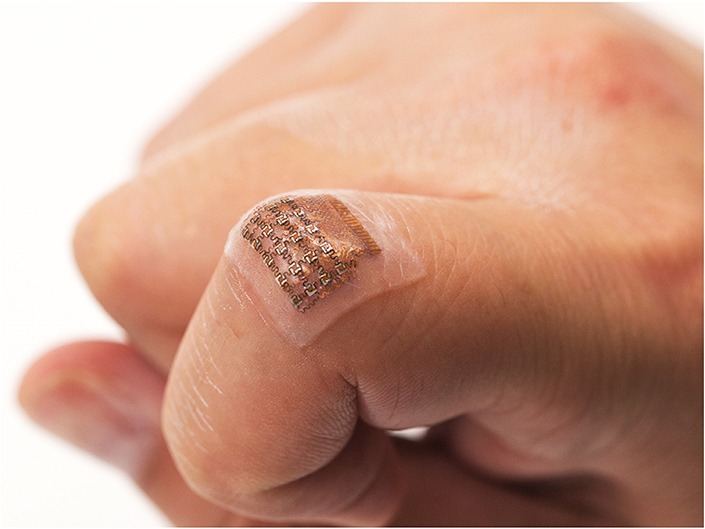
This soft, stretchy electronic patch uses ultrasound to noninvasively monitor blood pressure deep inside the body. Photo courtesy of Sheng Xu lab



Stay in the Know
Keep up with all the latest from UC San Diego. Subscribe to the newsletter today.
