UC San Diego Hosts Finale of Nationwide Nanotech Summer Research Program

Story by:
Published Date
Article Content
Undergraduates from around the country recently gathered at the UC San Diego Qualcomm Institute (QI) to present the outcomes of their summer research projects using nanotechnology in a wide range of applications, from quantum computing to medicine.
“Hands-on research experience is invaluable for these students, who are figuring out what direction to take their careers,” said QI Program Manager for Education and Outreach Yves Theriault, who organized the convocation. “You cannot do research only on paper. You need to get in the lab, try the experiments, and optimize processes.”

“You cannot do research only on paper,” says QI Program Manager for Education and Outreach Yves Theriault, who organized the Research Experience for Undergraduates Program convocation. “You need to get in the lab, try the experiments, and optimize processes.” (Photo by Areli Alvarez)
The summer’s program — officially called the Research Experience for Undergraduates (REU) Program — was sponsored by the National Nanotechnology Coordinated Infrastructure (NNCI), which is concluding the tenth and final year of its mandate from the National Science Foundation (NSF) to facilitate nanotechnology research and education. Part of a 20-year history of federal initiatives in the field, the NNCI has supported 16 centers of excellence across the country, including the San Diego Nanotechnology Infrastructure (SDNI), where Theriault is executive director for education and outreach.
Welcoming the students to QI were Theriault; SDNI Faculty Director and UC San Diego Jacobs School of Engineering Professor Yuhwa Lo; and Director of NNCI Coordinating Office David Gottfried.
Also introducing the program was Mikkel Thomas, director of the NNCI Education Working Group, who encouraged students to use the summer experience as a “data point” to think about where to go with their careers. He also emphasized the importance of the field of nanotechnology.
“Nanotechnology is everywhere,” he said. “We use it every day, but most people have no idea.”
Students Speak
At the heart of the convocation were talks and poster presentations by the 51 students, who came from universities big and small.

Zoe Bell , an aerospace engineering major at Arizona State University, says over the summer she became interested in biology and might add it as a minor “since biology in space could change a lot of lives.” (Photo by Mika Ono)
Zoe Bell, a rising sophomore and aerospace engineering major at Arizona State University (ASU), worked in Assistant Professor Nick Rolston’s lab on a project that examined how various metals held up in conditions that mimicked outer space.
“I learned a lot this summer, especially about fabrication,” said Bell, who envisions a career in industry. “I earned a certification in nanotechnology. I also became interested in biology and might add it as a minor, since biology in space could change a lot of lives.”
Collet Akins, a rising junior at Lehigh University in Pennsylvania, conducted research in Professor Steven Jacobsen’s lab at Northwestern University to help understand the composition of the Earth’s mantle.
“I got hands-on experience with microscopy techniques that I don’t have access to at my school,” Akins said. “Everyone has been great, and I really enjoyed the program. After doing this, I want to go to grad school.”

Miguel Alvarado, a rising senior at Northeastern Illinois University, explains his project that assesses a strategy to use layers of different materials to make quantum computer bits (qubits) work more efficiently. (Photo by Mika Ono)
Miguel Alvarado, a rising senior at Northeastern Illinois University who worked in Professor Vinayak Dravid’s Northwestern University lab, assessed a strategy that used layers of different materials to make quantum computer bits (qubits) work more efficiently.
“This was my favorite research project yet,” he said. “I want to keep working in this field and get my Ph.D. I’m looking at Northwestern and UC San Diego, as well as other graduate schools.”
‘One Quarter at a Time’
In addition to the student presentations, the event included panels to help participants explore career options.
In the first panel, four UC San Diego Jacobs School of Engineering graduate students — Ricardo Buarque, Freddy Garcia, Kyle Lewin and Sean McDowell — spoke about their backgrounds, acceptance to graduate school and methods for financing their educations.
Theriault noted that, although fellowships can facilitate the acceptance of a student in a principal investigator’s lab, a limited number of fellowships are available. Nonetheless, many students make graduate school possible with support from a PI’s research and an attitude of persistence and creativity, as shown by the “fantastic” participating panelists.
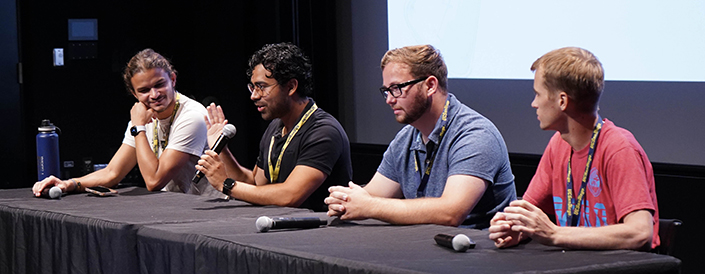
“I’m dealing with [funding] one quarter at a time,” says UC San Diego graduate student Freddie Garcia (second left). Panelists also included UC San Diego graduate students Ricardo Buarque (left), Kyle Lewin (second right) and Sean McDowell. (Photo by Areli Alvarez)
Buarque, a student from Brazil working in Associate Professor of Chemical and Nano Engineering Tod Pascal’s lab, for example, pieced together funding for his education with six months of funding from his parents, a scholarship from the Clara Lionel Foundation, support that resulted from networking with foundation representatives and donors, and earnings from teaching and research jobs. In addition, he minimized costs with shared housing.
Garcia, a Long Island native, was a NNCI REU participant during the COVID pandemic who connected with Associate Professor of Chemical and Nano Engineering Oscar Vazquez Mena during that experience. Garcia was accepted as a graduate student in Vazquez Mena’s lab and has supported his studies through a first-year fellowship, a Sloan Foundation scholarship, and graduate student researcher, teaching assistant and tutor positions.
“I’m dealing with [funding] one quarter at a time,” said Garcia. “It’s working out for me so far.”
Both Lewin and McDowell are part of Professor of Chemical and Nano Engineering Nicole Steinmetz’s lab. In their path to graduate school, both identified scientists whose research interested them and reached out — Lewin said for him it was “about 142 cold emails.” Their funding has included income from savings from full-time work (McDowell took several years to apply to graduate school) to odd jobs, such as handyman work.
Entrepreneurship as a Path
Moderated by Theriault, who leads innovation and entrepreneurship programs at QI, the second panel focused on entrepreneurship. Panelist Steve Oldenburg spoke about his experience as a serial entrepreneur whose ventures include nanoComposix (now a Fortis Life Sciences Company), Sienna Biopharmaceuticals and La Jolla NanoMedical.
“One thing that I found over and over is that invention rarely happens at the desk,” he said. “You’ve got to be in it. And then you see these little nuances. It’s in the details, and one or two steps down where you can add something that’s truly novel enough to move forward. That said, overall — and this is what I encountered for the full time at nanoComposix — ideas are relatively cheap, and the execution is really where that challenge is. It is that relentless focus on trying to execute on a daily basis that really gives you success.”

The nanotechnology convocation students and organizers gather in front of the landmark Bear sculpture in the Qualcomm Institute courtyard. (Photo by Mika Ono)
Matt Hull, director of the Innovation and Entrepreneurship Working Group at NNCI and research professor at Virginia Tech, also spoke, addressing his experience launching his company, NanoSafe, and the possibilities available to the program’s participants now they have research experience.
“Entrepreneurship is a path,” Hull told the group. “My punch line is that it’s not about starting companies. It’s more about understanding what you can do with a research career and what your internal compass is telling you.”
Future in the Balance
Hull also encouraged interested students to participate in the Nanotechnology Entrepreneurship Challenge, which will be held in the fall instead of the spring this year. Top teams receive $1,000 to develop their ideas and compete with other participants.
Hull noted the UC San Diego teams that Theriault has coached have done extraordinarily well in previous competitions, winning first place for three years in a row and third in the past year’s competition. The latest SDNI team — UC San Diego postdoctoral fellow Patrick Opdensteinen, bioengineering Ph.D. student Seongwon Jung and Lewin — focused on producing medicine using plants as bioreactors.
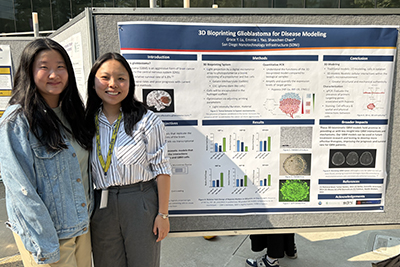
UC San Diego undergraduate Grace Lu (right) and Ph.D student Emmie Yao stand in front of a poster that explains their project in the Chen lab to help understand glioblastoma, an aggressive form of brain cancer. (Photo by Mika Ono)
While the nanotechnology community waits for the next NSF nanotechnology initiative to take shape, Theriault emphasizes that U.S. leadership in science and innovation depends on continued support to universities.
“Scientific research — fundamental research — is important,” he said, pointing to life-changing advances such as the structure of DNA, mRNA vaccine technology, CRISPR, and other important applications such as quantum dots, quantum computing and wireless communication. “These developments and their widespread applications come from the fact that this country has excelled at supporting academic research for years. This research is the powerhouse for innovation in this country and in the world. If the U.S. wants to remain a leader, it is important to continue investing in academic research.”
To learn more about nanotechnology and education at QI, see the Nano3 Cleanroom Facility and Education web pages. To learn more about the Jacobs School of Engineering graduate programs, visit its Graduate Students page.
Share This:



Stay in the Know
Keep up with all the latest from UC San Diego. Subscribe to the newsletter today.
