Research Alerts
Hearing a Molecule’s Solo Performance


Published Date
Article Content
When things vibrate, they make sounds. Molecules do too, but at frequencies far beyond human hearing. Chemical bonds stretch, bend and twist at characteristic rates that fall in the infrared region of the electromagnetic spectrum. Infrared spectroscopy, which measures how light excites these vibrations, is often likened to listening to a molecule's voice.
Each molecule has its own unmistakable tone – a vibrational “fingerprint” that reflects not only its chemical structure but also the nanoscale environment around it. But the voices of individual molecules are so faint that traditional infrared spectroscopy can only detect the collective chorus of millions or billions of molecules at once.
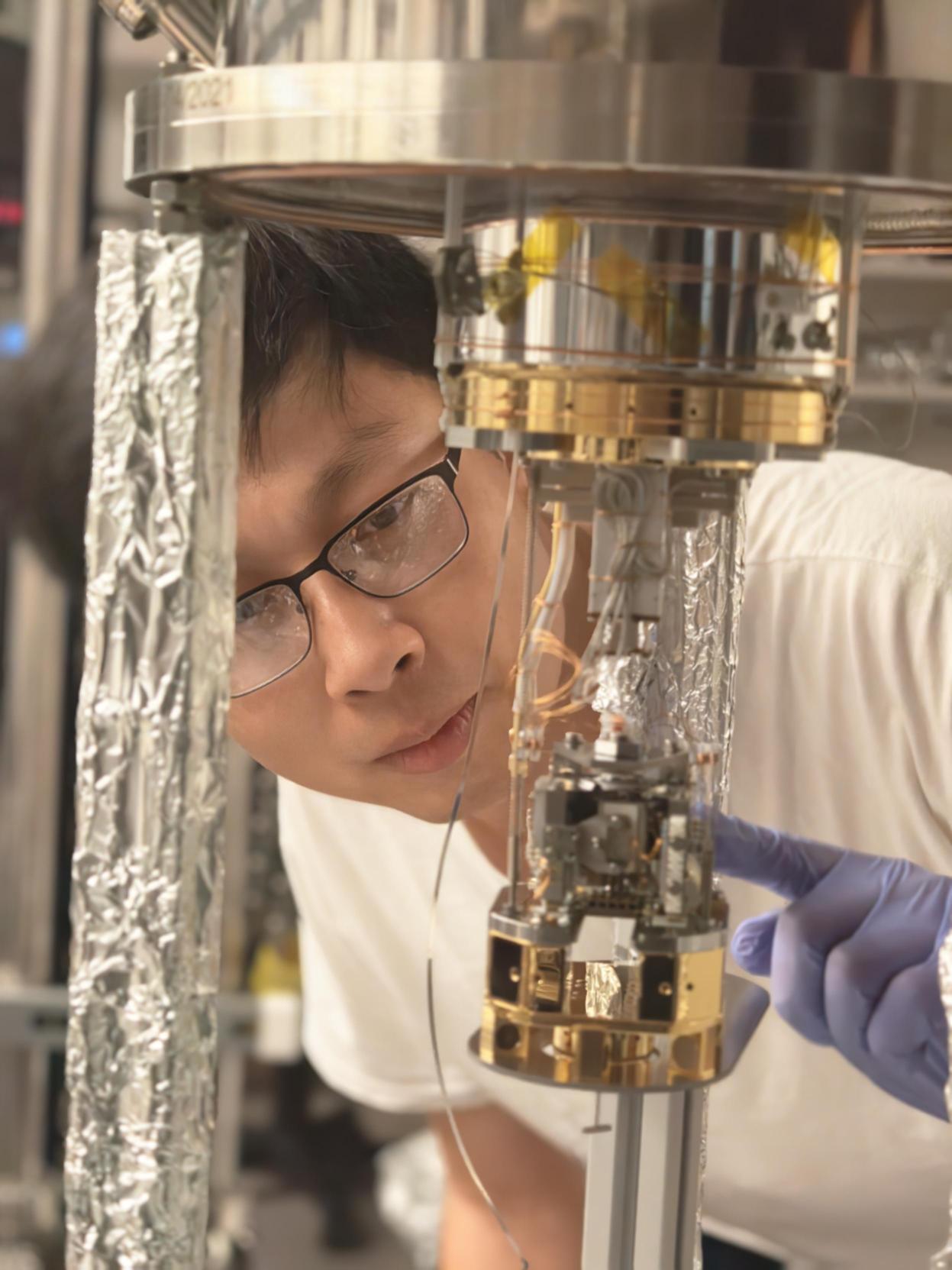
Li with IRiSTM intrument.
Now researchers at University of California San Diego, led by Shaowei Li, have found a way to hear a single molecule sing, using an approach they call infrared-integrated STM, or IRiSTM. It combines infrared excitation with scanning tunneling microscopy, a technique best known for imaging individual atoms and molecules by measuring the quantum tunneling of electrons between a sharp metal tip and a surface.
Chemists have long dreamed of controlling reactions by depositing energy into a single bond, steering molecules along desired pathways, and single-molecule infrared spectroscopy brings that dream one step closer to reality.
The study published February 19, 2026 in Science and was led by Shaowei Li, Kangkai Liang, Zihao Wang, Weike Quan, Yueqing Shi, Hao Zhou, Liya Bi, Zhiyuan Yin, Nathan Romero and Mark Young. Their research was funded, in part, by the National Science Foundation (CHE-2303936 and DMR-2011924) and the Department of Energy (DE-SC0026181 and DE-SC0025537).
Read the study in Science: “Single-Molecule Infrared Spectroscopy with Scanning Tunneling Microscopy.”
Read more news about: Physical Sciences
“Infrared spectroscopy is one of our most powerful tools, but until now it has always been an ensemble technique. This gives us a way to see, at the most fundamental level, how vibrational energy couples to molecular motion.”
Share This:



Stay in the Know
Keep up with all the latest from UC San Diego. Subscribe to the newsletter today.
