Research Alerts
First Ever Reported Cryo-EM Visualization of E. coli TGT Structure


Published Date
Article Content
The enzyme tRNA-guanine transglycosylase (TGT) chemically modifies transfer RNA (tRNA) and plays a key role in how disease-causing bacteria control the production of proteins needed to cause infection. E. coli TGT is nearly identical to the one found in Shigella, which causes the intestinal infection shigellosis. Traditionally, scientists have used E. coli TGT as a primary model to understand how TGT works; however, they have struggled to visualize the atomic structure of E. coli TGT, because the protein is difficult to crystallize, limiting their ability to learn more about the enzyme.
Now, researchers in the lab of Neal Devaraj, Professor of Biochemistry and Molecular Biophysics at UC San Diego, have determined the cryo-electron microscopy (cryo-EM) structure of E. coli TGT and captured how it engages its tRNA substrate. Unexpectedly, the team found that the enzyme binds and acts upon two tRNAs, overturning the prevailing model for how bacterial TGT functions. This finding provides a more complete picture of how the enzyme actually engages RNA and may assist in drug-design efforts.
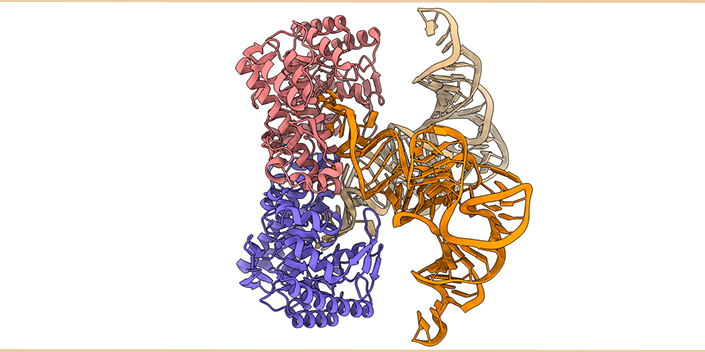
Structure of E. coli TGT. The enzyme has two tRNAs (highlighted in orange and ochre) bound in its active sites. (cr: Neal Devaraj lab / UC San Diego)
Overall, this research provides a more accurate structural framework for future efforts to develop inhibitors targeting TGT, which has long been investigated as an antivirulence target in drug-resistant Shigella. Additionally, it may also prove useful in a variety of RNA chemical biology applications, as scientists can now design RNA substrates for TGT that take advantage of both binding sites in the enzyme.
The study was published July 21, 2026 in Proceedings of the National Academy of Sciences and was led by Neal K. Devaraj and Alexander Harjung. Additional authors include, Ember M. Ruth, Mariusz Matyszewski, Jaehee Park, Caroline Knittel and Evan McCormack (all UC San Diego). Their research was funded by the National Institutes of Health (R35 GM141939).
Read the study in PNAS, “Cryo-EM reveals that Escherichia coli tRNA-transglycosylase can bind and act upon two tRNAs.”
Read more news about: Physical Sciences
“This structure gave us a new way to think about how TGT works. Now that we understand the enzyme can bind two tRNAs at once, we can design an RNA that takes advantage of that, binding several times more tightly than the RNAs we've used before.”
Share This:
You May Also Like


Stay in the Know
Keep up with all the latest from UC San Diego. Subscribe to the newsletter today.
