Dissecting the Argument: A New Book Teaches Critical Reading Skills for Science
The CERIC Method gives students and instructors an evidence-based approach to reading


Published Date
Article Content
Reading has been on the decline for decades. Researchers have documented falling rates of college students completing assigned reading since the early 1980s — well before smartphones, and long before an AI chatbot could summarize a journal article faster than you can microwave a burrito. Yet, when STEM majors begin research and advanced courses, they are already expected to know how to critically read scientific research articles, even if no one has ever taught them how.
This is one of the reasons two scholars from the University of California San Diego — alumna Genevive Bjorn, MEd ‘15, founder and director of The Higher Learning Lab; and alumnus and Professor of Astronomy and Astrophysics Adam Burgasser, BS ‘96 — wrote “How to Critically Read the Scientific Research Literature: Introducing the CERIC Method,” recently published by Cambridge University Press.
In this Q&A, Burgasser explains why critical reading skills in science matter and how to use the CERIC Method.
Why are literacy and critical reading skills important in science?
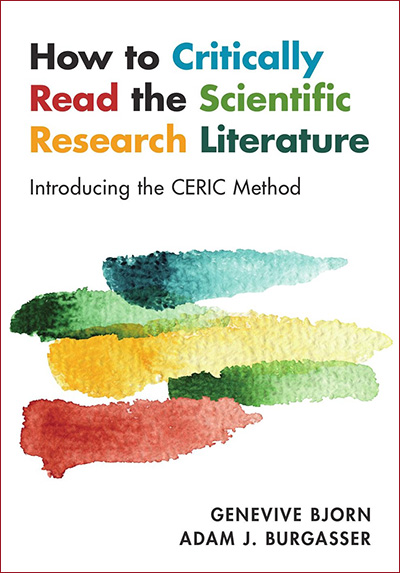
Bjorn and Burgasser's book was recently published by Cambridge University Press.
Critical reading is how we make sense of the scientific literature, enough to interpret it, apply it and critique it. Reading the words on a page alone doesn’t encompass these higher-level skills. Beyond my own observations of declining reading skills in the classroom, UC San Diego’s own Senate-Administration Workgroup on Admissions has documented a decline in language and literacy skills among recently admitted students.
Why did you feel the need to write a book?
Critical reading is a pillar of scientific practice: we read the scientific literature to understand the problems; formulate, critique or test ideas; and anchor our writing. Yet critical reading is generally treated as an assumed skill, one that teachers and mentors expect students to know without providing any formal instruction or research-based validation. We call this part of the “hidden curriculum” in science. Dr. Bjorn and I both experienced this as novice researchers — we were expected to read and understand articles, but weren’t shown how information is organized, what is most important in an article, how to parse the language or how to tell when an article has flaws.
Educational research (including our own) shows that difficulties reading scientific literature are among the main barriers to degree progression and one of the top reasons students drop out of graduate programs. Rather than replicate ill-defined, informal and untested practices, this book aims to provide an evidence-based approach to fully engage with the scientific literature.
What is the CERIC Method?
CERIC stands for Claim, Evidence, Reasoning, Implications and Context, which are the five main components of a scientific research argument. The CERIC Method is a structured reading approach that helps novice readers and experienced researchers quickly identify an article's main finding (Claim), the arguments that support it (Evidence and Reasoning), and its relevance in the research ecosystem (Implications and Context).
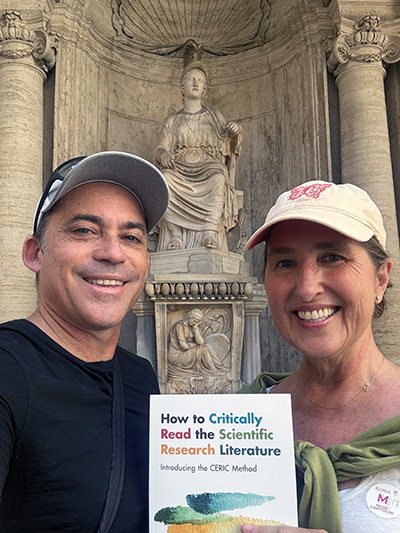
(l-r) Burgasser and Bjorn have been sharing their book around the world, including here, at the Capitoline Museum in Rome.
Is this book useful to non-scientists?
Well, I would argue anyone interested in understanding how the world works is a scientist! And yes, this approach has value across academic fields. We’ve taught the CERIC Method to education research students and religious studies graduate students. We’ve conducted CERIC trainings for citizen science groups, high school students and, more recently, retirees on a cruise ship. Our research shows that CERIC increases comprehension and engagement over a wide range of research topics, although our focus has been on the scientific literature where we see the biggest challenges in reading engagement.
Can you give an example of how one might use CERIC?
A good way to think about the approach is “hunt and seek.” Let’s say you’ve just been assigned a research article for an advanced science course. Rather than try to read the whole thing from start to finish, start with just the title and the abstract. The abstract usually contains most of the CERIC elements, and a well-written article states its main claim as a title. For example, “Discovery of a potentially habitable world” is a pretty clear claim. Take notes on all the CERIC elements you find in these parts of the paper.
Now consider: what is missing? Because the abstract is short, there is always missing information, and you’ll need to dive into the main article to find it. But you can do this strategically — this is the hunt-and-seek part. For example, maybe you don’t know what their sample size is, whether they had a control case, or what calibrations they did. This suggests missing evidence, which is usually found in the “methods” section of an article or in the tables. A focused search of this section, with these questions in mind, helps you fill in the details on this key element of their research argument. Similarly, if it’s not clear what problem they were trying to address, do a focused search of the “introduction” section where the motivation for the study is most often found.
The key to the CERIC Method is to focus reading on the five main components of the scientific argument and not get bogged down in the language or structure of an article. Importantly, if any of these elements are missing or incomplete, this analysis becomes a way of critiquing a research study — an essential component of the scientific peer review process. It is also an excellent way to improve our own research writing.
What do you hope readers will get out of this book?
This book is meant to be a resource for both novice researchers and their mentors. For novice readers, I hope the CERIC Method serves as a useful scaffold that helps them approach articles that can be difficult, confusing and even scary to read. We have already seen in our research that CERIC reduces this kind of reading apprehension. I also hope novice readers find ways to build on this model and make critical reading a personal, even creative habit. For example, I’ve had students show me how they use multi-color highlighting or mind maps to organize CERIC elements, which helps them make sense of science arguments.
For mentors and instructors, I hope they find the book a helpful resource for integrating critical reading pedagogy into their courses and research training. The book provides many examples across science fields, and our website provides free teaching resources, including worksheets and grading rubrics, based on my courses at UC San Diego and our broader CERIC workshops. My hope is that critical reading instruction using evidence-based approaches, like CERIC, becomes a core component of college science education, rather than leaving students to figure it out on their own.
Learn more about the CERIC Method, find free resources, and order the book, “How to Critically Read the Scientific Research Literature: Introducing the CERIC Method,” on the CERIC Method website.
Read more news about: Alumni, Physical Sciences
Share This:


Stay in the Know
Keep up with all the latest from UC San Diego. Subscribe to the newsletter today.
